Нажмите, чтобы развернуть оглавление
Содержание
Choose the finish on an actual shoe design, starting with the appearance the brand wants and then comparing candidate surfaces under the same viewing, bending, handling and care conditions. A leather grain description and a finish description answer different questions. Neither tells you, by itself, whether the finished upper will maintain its intended appearance in use. For one style, the useful decision is therefore a specified leather article and finish, a physical appearance reference, and evidence about the changes that matter for that shoe. A naturally varied surface may be exactly right for one intended look; a more uniform surface may be right for another. The choice becomes defensible when the brand can say which variation is intentional, which change is unacceptable, and how the approved sample will be recognized again in bulk.
What is being chosen when a brand chooses an upper finish?
The brand is choosing the upper’s visible surface treatment on a particular leather article, not buying a universal grade called “good leather.” The grain side is part of the hide; correction can alter that surface; finishing adds or modifies what is exposed to sight and contact. Those are related layers of the decision, but they are not interchangeable labels. Leather Working Group’s terminology distinguishes grain descriptions, while its leather-making guide explains how different finishes create different appearances.
This matters on a dress shoe: the vamp bends, and the pair presents two uppers whose shade and texture must work together. A swatch cannot show every effect after cutting and lasting. Specify the leather article and finish, then examine both on the intended pattern; a similarly named finish on another substrate is a different comparison.
What do full-grain and corrected-grain claims actually tell a dress-shoe buyer?
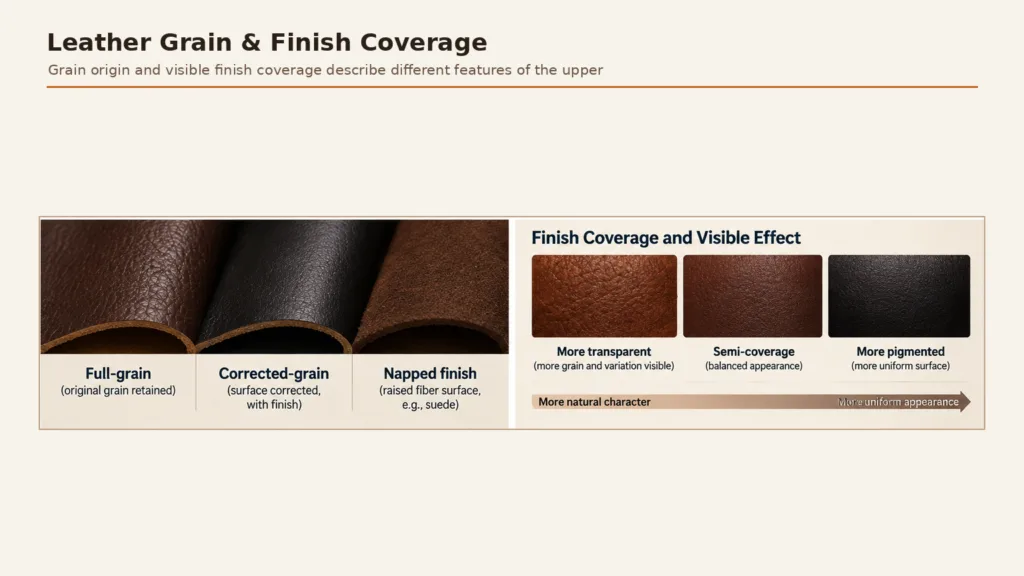
Full grain describes leather whose original grain surface has not been mechanically corrected; corrected grain describes a surface that has been mechanically altered and then enhanced through finishing. These names describe how the surface was prepared. They do not, alone, report the upper’s flex behavior, finish adhesion, care response or finished-shoe life. That is the practical meaning a buyer needs before treating either term as a selection rule. Leather Working Group defines both terms within leather terminology rather than as complete footwear performance grades.
The distinction also prevents a common category error. “Full grain” does not necessarily mean that the shoe displays a highly natural-looking surface: the finishing choices still affect how much grain and variation remain visible. “Corrected grain” does not automatically mean that every finished surface has the same gloss or depth of pigment. The material history and the finish coverage are two axes; an actual article occupies a position on both. A buyer who requests “full-grain black” without defining the surface appearance could receive different degrees of sheen or visible character while the grain term remains accurate.
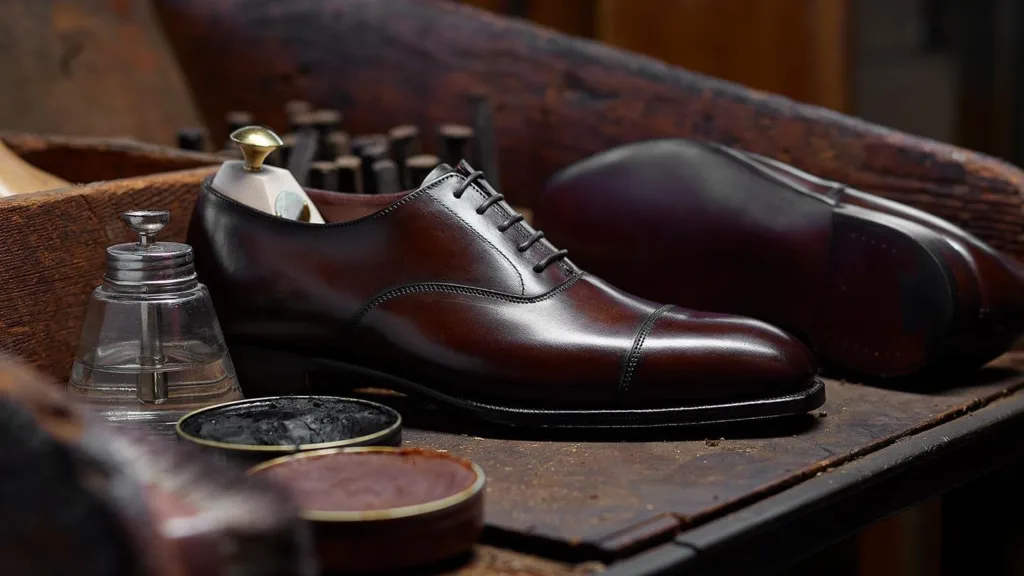
Consider a hypothetical pair of sample descriptions: one says full-grain leather with a more transparent finish, and another says corrected grain with more pigment. The first is more likely to expose natural variation; the second may present a more even-looking surface. Those are hypotheses about appearance from the descriptions, not measured results for either shoe. The brand still needs to see the materials in comparable panels and examine the use conditions. The point is to ask the label the question it can answer—surface origin—while asking the finished sample the questions about visible result and behavior.
How does finish coverage change what the buyer can see?
More transparent finishing leaves more of the underlying grain and its variation visible; more pigmented coverage can make the presented surface more uniform. The mechanism is visual rather than a quality ranking. Light reaches and returns from the surface differently when the grain texture is exposed than when an applied color layer masks more of it. The leather-making guide describes finishing as a way to alter appearance and handle, which is why a grain label cannot stand in for a finish specification.
On a finished pair, variation has a context. Fine differences may support a natural look, while an abrupt left–right shade mismatch can look accidental. Define the intended limit with an approved upper or pair; a flat color code may miss texture and gloss on curved areas.
Which visible trade-offs should the sample comparison test?
Test grain visibility, gloss, shade consistency and the visibility of ordinary surface marks on the same design. These are different attributes: a finish can deliver the desired gloss but show a different amount of natural variation, and an even-looking panel can look different once cut into a curved toe and a flexing vamp. The comparison should identify what the brand wants the customer to see, then ask which sample delivers that appearance consistently enough for the intended style. It should not translate every visible difference into a claim about durability.
The table is a decision aid for one shoe style. Its rows describe plausible surface options, not an ordered league table; the last column tells the buyer what to observe rather than awarding an unverified performance score. The grain and finish distinctions come from Leather Working Group’s definitions and guide, and the napped-surface care distinction is supported by Leather Naturally’s care guide.
| Grain or surface treatment | Finish coverage and visibility | What the same-condition sample can show | Wear or care condition to consider | Selection implication |
|---|---|---|---|---|
| Full grain with transparent or low-pigment finish | More natural grain remains visible | Variation across vamp and between paired uppers | How visible marks and cleaning changes appear | Choose when that character is intended and approved on the actual shoe |
| Corrected grain with pigmented finish | Surface can look more even | Shade and gloss consistency on matched panels | Forepart flex and finish adhesion | Compare actual crease and peeling behavior; the label does not prove resistance |
| Suede or another napped surface | Texture and nap direction dominate appearance | Directional shade change on the same upper shape | Brushing, wetting and finish-specific care | Use only when the intended look and maintenance expectations suit this style |
Decide the acceptable variation across the actual pair before judging the options: natural tonal movement may be intentional, while an abrupt left–right mismatch may not be. A visually attractive sample still needs separate evidence for its wear behavior.
What must stay comparable when two finish samples are viewed?
Keep the pattern, upper construction, leather article or comparable substrate, reference shade, lighting and viewing angle consistent enough that the finish is the meaningful changed variable. A side-by-side photograph of different shoe shapes, made under different lights, cannot settle which finish creates the preferred appearance. The curved toe, stitched seams and vamp creases affect highlights and texture. Compare matched panels first if needed, then compare finished or near-finished shoes so those shapes are represented.
For a practical review, place both candidates in the same neutral light and examine the left and right uppers together. Look straight on, then at ordinary walking and handling angles; the point is to discover whether gloss or shade differences appear only under a particular angle. Record whether the change is part of the intended character or a mismatch the brand would reject. If the samples use different hides, thicknesses or color formulations, keep that difference visible in the decision record. It may still be useful to compare them as complete options, but it would be wrong to credit the finish alone for a result produced partly by the substrate.
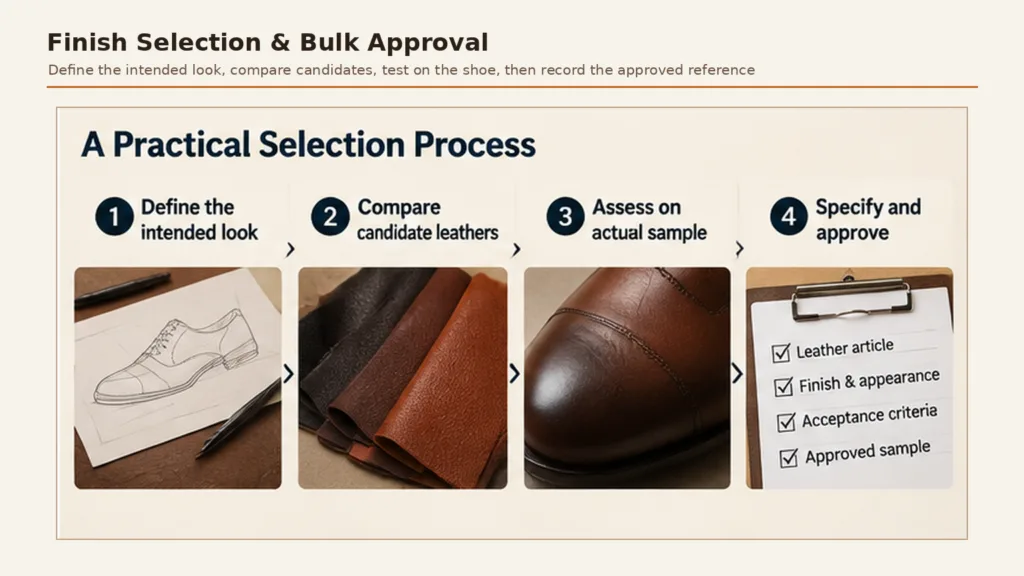
A named color is not a sufficient reference. Even with the same color name, texture and finish coverage can change perceived depth. The leather-making guide treats appearance as an outcome of processing, which supports using an approved physical sample as the comparison anchor. Photograph the reference under defined light if communication across locations requires it, but keep the actual approved sample as the authority for surface character. This is a selection method, not a claim that a photograph or a color number alone reproduces the material.
Which wear conditions can change the finish choice?
Forepart bending, repeated contact, moisture and the expected care routine can change which finish is suitable, because they act through different mechanisms. A surface may look convincing while flat yet change at a crease, lose adhesion at an interface, or look different after cleaning. Treat each as a separate question. The brand does not need to assume that the most natural-looking or most heavily coated option wins; it needs to decide which changes matter for the intended shoe and observe the actual sample under relevant conditions.
The vamp bends as the wearer walks; other areas encounter handling and rubbing. Moisture can change appearance without causing a crack or peel. Distinguish those observations from one another so a favorable photograph is not mistaken for proof of wear behavior.
What does flexing at the vamp reveal that a flat swatch misses?
The vamp repeatedly bends and creases in wear, so flexing can expose cracking or other crease damage that a flat, stationary swatch cannot reveal. A relevant check uses the intended upper material and finish, and ideally includes a sample shoe because cutting and lasting change how the surface folds. SATRA’s flex method is evidence that flex behavior is a distinct property to assess; its existence does not mean any candidate article has passed it.
Look at where the design actually bends. A broad vamp with a particular pattern and lasting tension may form a different crease than a flat panel of the same hide. In a comparison, observe whether a surface change is a normal fold, a change in gloss along the crease, or visible cracking of the finish. Those observations have different meanings. A crease alone is not automatically a failure, and a sample that looks pristine before bending has not yet answered the wear question. If the intended market exposes the shoe to colder or wetter conditions, the relevant flex condition may differ from a dry room-temperature demonstration. Record the condition alongside the observation instead of generalizing one result to every setting.
This is why “more coating” is not itself a sufficient wear strategy. A coating may mask variation in an unused sample, yet the chosen layer and its bond with the leather must still behave acceptably where the upper bends. Compare the actual alternatives under a suitable method or controlled sample-wear observation, without inventing a universal pass threshold. The decision needs a defined acceptable appearance after flex, not just a material name.
When does finish adhesion or care compatibility matter more?
Finish adhesion matters when the visible layer could lift or peel from the underlying leather; care compatibility matters when expected cleaning could change the intended surface. These are separate from flex cracking. A sample can retain its color in a static display yet have an interface problem under contact, while another can remain intact mechanically but change appearance after an unsuitable cleaner. SATRA’s finish-adhesion equipment description reflects the need to evaluate attachment as its own property; it supplies no test result for a particular shoe.
Translate those mechanisms into selection questions. If the planned finish relies on a pronounced surface layer, examine whether the layer remains attached in the relevant handling and bending areas. If the target customer expects to polish or wipe a formal shoe frequently, determine whether the actual finish and care system support that action. For a napped or delicate surface, the maintenance path may be materially different from a smooth coated upper, as Leather Naturally’s care guide makes clear. The choice should include that ownership experience, but this article stops at its selection implication. Writing the customer’s detailed instructions after the finish is selected is a separate task.
How should candidate finishes be compared on one dress-shoe design?
Compare identified finish variants on matched versions of the intended shoe, and judge appearance, bending, surface contact and care response against the same target. Begin by naming the look in observable terms: desired texture visibility, acceptable shade movement across a pair, gloss at ordinary viewing angles, and any mark that would be unacceptable. Then obtain alternatives that can be traced to their actual leather articles and finish descriptions. If the substrates differ, treat the comparison as a comparison of complete material options, not a controlled test of finish alone.
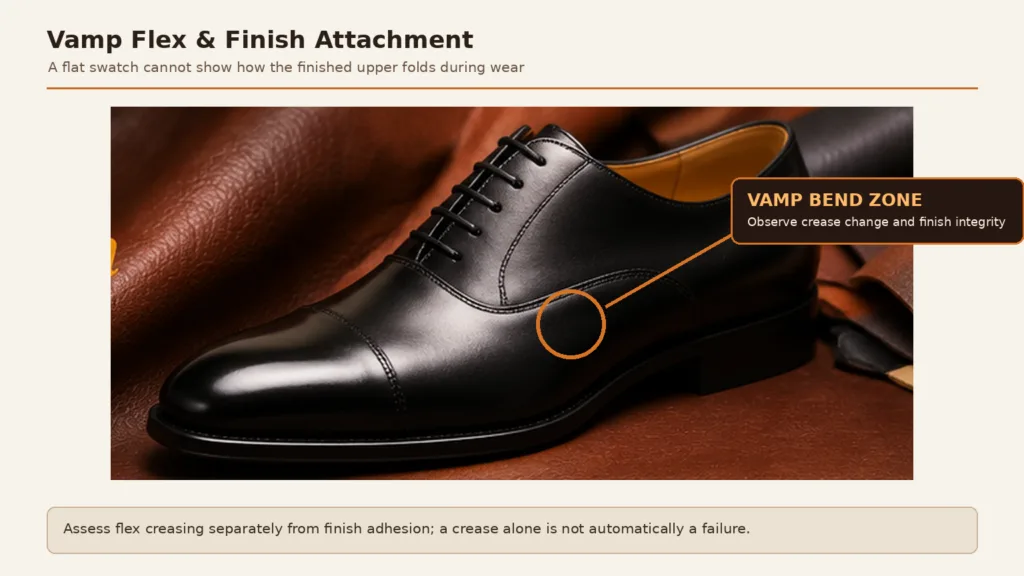
Review the options in a sequence that preserves the meaning of each observation. First compare them in one light and at the same angle, looking at the whole pair as well as the toe and vamp. Next, examine the forepart on the same shoe construction after representative bending or a relevant flex assessment. Then look at high-contact areas and the effect of the proposed care method on a discreet sample area. A change in sheen, a crack, a lifted finish and a cleaner-induced mark are different observations; record them separately. The SATRA flex и adhesion resources illustrate why one favorable check cannot substitute for the other.
What decision should the brand record before bulk approval?
Record the selected leather article and finish, the approved physical appearance reference, the viewing conditions used to approve it, and the particular surface changes the brand will accept or reject. The decision must be reproducible: another sample or bulk pair should be compared against the same reference rather than a vague description such as “similar black leather.” The record should say whether natural grain variation is expected, what left–right matching means for this style, and whether gloss or shade shifts at the vamp are acceptable after ordinary flex.
Separate three kinds of statement. “This is the approved appearance” refers to the sample and viewing conditions. “This finish passed a specified check” requires an actual result on the identified article under that method. “This shoe will remain unchanged in use” would be a much broader promise and cannot be inferred from either of the first two. Keeping those claims distinct helps the brand approve a style without overstating what a sample review proves. If the leather article, finishing recipe, color or construction changes, reassess the affected observations rather than assuming that the old approval transfers automatically.
The same principle applies to care. The selected finish should be accompanied by a compatible, finish-specific care direction before the product reaches the wearer; a generic polish line can undo the surface appearance the brand approved. That is a handoff from the choice made here, not an invitation to add a full care guide to this decision. A private-label buyer can bring the intended shoe design, appearance reference and use expectations to a sample discussion with Hengxin. The useful next step is to compare actual material options against that defined target and agree which observations must be repeated before bulk approval.