Click to Expand Table of Contents
Table of Contents
Choose the supplier type from the control and service the order requires
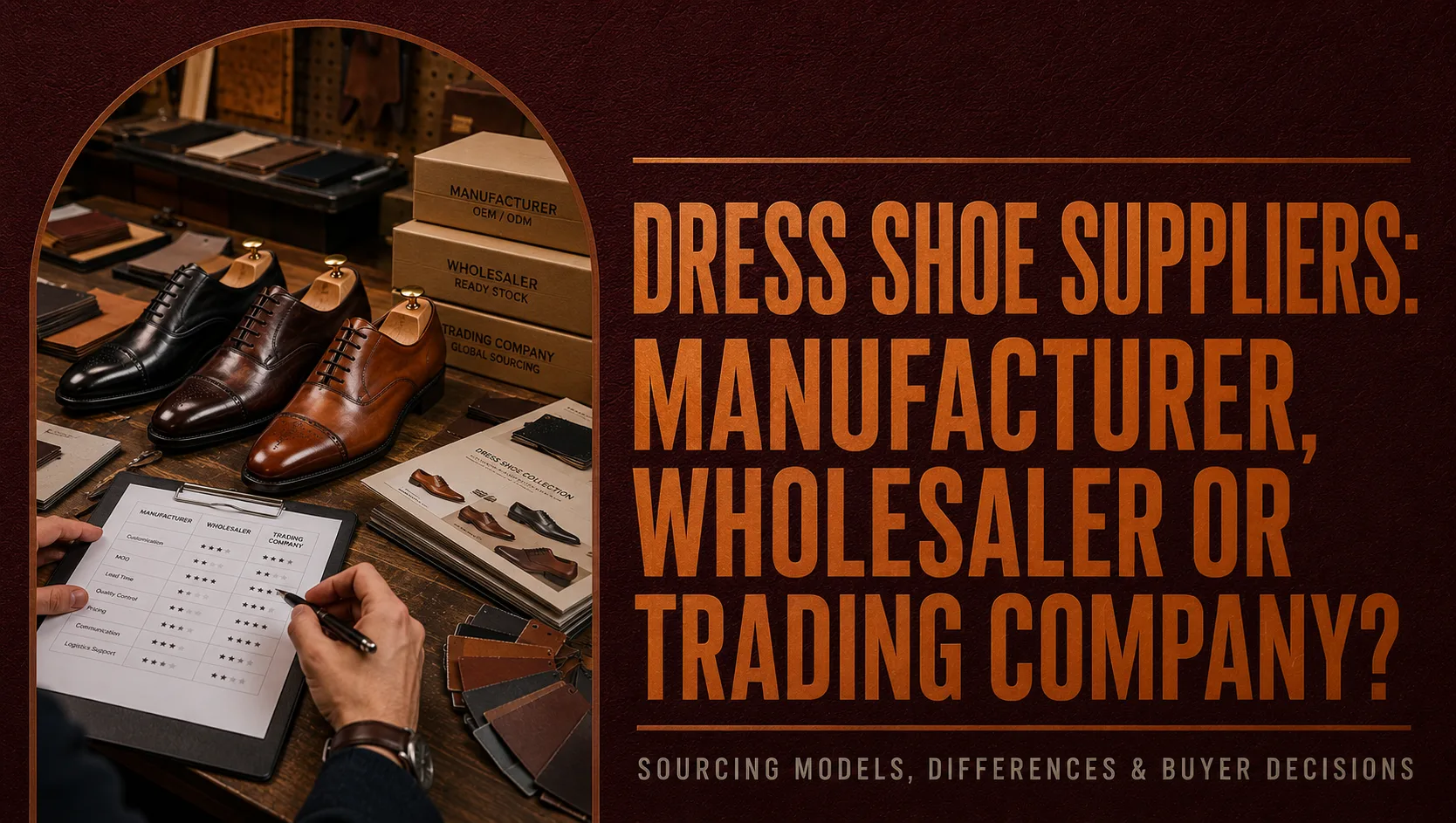
For B2B commercial teams, dress shoe supplier should be evaluated through counterparty role, factory access, assortment flexibility and accountability. The practical question is not whether a supplier can send an attractive reference product or a short quotation. It is whether the chosen counterparty model matches the buyer’s volume, development needs, control level and internal resources. The same supplier label can conceal very different control paths; an intermediary may add useful service, but the buyer must know who makes decisions and who is accountable. A disciplined decision therefore starts with the operating model, converts it into evidence requirements and only then compares commercial terms.
This page is a decision guide for footwear and menswear brands, importers, wholesalers and distributors choosing between a manufacturer, wholesaler or trading company. It is deliberately bounded: The original China supplier ecosystem keyword is moved to N091; no generic China geography positioning is targeted here. Commercial teams who still need a broad capability screen can use the footwear manufacturer capability checklist, while the dress shoe manufacturer selection guide covers the adjacent decision without replacing this page’s role.
Define a dress-shoe sourcing route before Supplier Contact
Write a Commercial and Technical Brief
A useful brief explains the customer, price position, intended use, launch window and assortment logic before it lists materials. For a dress-shoe sourcing route, define the product family, construction, size range, colors, expected quantities, brand treatments, packaging and target market. State what is already approved, what needs supplier input and which choices remain conditional. This prevents a dress shoe supplier from filling gaps with assumptions that later appear as price changes or reference product delays.
- State the product and customer role of a dress-shoe sourcing route.
- Define manufacturer, wholesaler and trader role disclosure and name the buyer-side decision owner.
- Record factory access, specification control and commercial responsibility with approval evidence and version control.
- Separate launch requirements from later options or replenishment ideas.
- Specify the commercial inputs required for a comparable response.
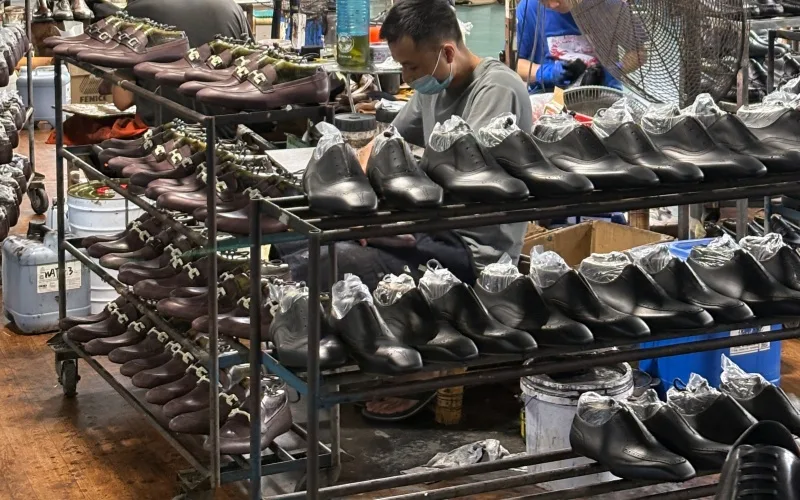
Separate Fixed Requirements from Negotiable Variables
Not every purchase requirement deserves the same status. Fit, regulatory requirements, protected artwork and customer-facing claims may be fixed, while leather selection, construction details or packaging can remain conditional within an approved range. Label each item as fixed, supplier-proposed or buyer-to-clarify. This classification gives the supplier room to solve legitimate constraints without silently changing the concept.
The brief should also record the decision boundary behind this article: The original China supplier ecosystem keyword is moved to N091; no generic China geography positioning is targeted here. That note matters because related search terms can lead teams into a different sourcing workflow. A controlled brief keeps the current buyer decision narrow enough to differentiate evidence and broad enough to expose dependencies.
Use a Dress Shoe Supplier Checklist
Manufacturer, Wholesaler And Trader Role Disclosure
Start with pass-fail gates before using a weighted score. A dress shoe supplier checklist should test category fit, the relevant process, access to current evidence, reference product discipline, quality responsibility and commercial transparency. A candidate that cannot identify the process owner or explain a material assumption should not receive extra points merely for a polished presentation.
The checklist must reflect counterparty role, factory access, assortment flexibility and accountability. Prompt the same core questions of every candidate and require the answer in a comparable form. Record the source, date and limitation of each important statement. This turns supplier evaluation into a traceable decision rather than a collection of impressions.
Decision gates for the first supplier screen
| Control | Evidence to request | Decision use |
| Manufacturer, Wholesaler And Trader Role Disclosure | Required evidence and decision owner | Define before supplier scoring |
| Factory Access, Specification Control And Commercial Responsibility | Approval record and change authority | Verify during sampling |
| Identify who owns criteria, inspection, corrective action and packing release | Criteria, records and escalation route | Verify before bulk release |
| Compare price with inventory service, consolidation, credit and accountability | Assumptions, exclusions and comparable quotation | Normalize before award |
Factory Access, Specification Control And Commercial Responsibility
Responsibility should be explicit across buyer, supplier and any intermediary. Identify who proposes, approves, purchases, stores, changes and releases each critical input. When factory access, purchase requirement control and commercial responsibility is vague, the commercial route can move forward operationally while ownership remains disputed. The correction is a signed responsibility matrix linked to the latest purchase requirement and reference product record.
- Confirm the decision owner and the evidence required for approval.
- Record the current version, open assumptions and deadline.
- Escalate contradictions before a new sample or quotation is authorized.
- Release the next stage only when the agreed evidence is complete.
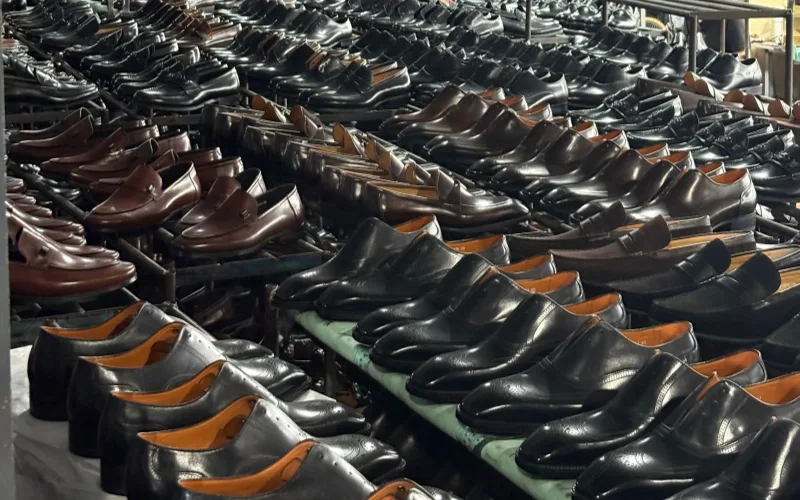
Control Dress Shoe Supplier Sample Development and Specifications
Verify who develops, approves, holds and reproduces the reference sample
Dress Shoe Supplier sample development should test the information flow as much as the physical shoe. The reference product request needs a versioned brief, reference materials, measurement or fit requirements, construction notes, brand placements, packaging direction and acceptance criteria. Supplier questions should be logged because they reveal which parts of the brief are not yet production-ready.
Review the reference product against the frozen inputs, not against memory. Comment sheets should distinguish defects, purchase requirement changes, optional improvements and questions. Once approved, photograph the reference, sign or digitally lock the record and identify which physical reference product controls bulk production. This approach supports verify who develops, approves, holds and reproduces the reference reference product.
Manage Revisions, Tooling and Release Records
A revision is commercial as well as technical. Changing the last, outsole, leather article, finish, artwork, size curve or packaging can affect tooling, material purchasing, yield, price and schedule. Require the supplier to show the impact before implementing the change. The approval record should state the version, reason, cost effect, timing effect and whether earlier materials or tooling remain usable.
Sample-to-bulk approval record
| Gate | Required record | Release question |
| Brief accepted | Versioned specification and open-question log | Are responsibilities and unknowns visible? |
| Sample reviewed | Comment sheet, measurements and material references | Does the sample answer the intended test? |
| Changes closed | Revision log with cost and schedule impact | Have affected inputs been re-approved? |
| Bulk released | Signed sample reference and packing criteria | Can production identify the controlling record? |
Verify Dress Shoe Supplier Quality Control and Evidence
Build a Dress Shoe Supplier Evidence Checklist
A dress shoe supplier evidence checklist should connect claims to current operating records. Useful evidence includes identity and authority documents, the factory relationship, relevant work orders, incoming material records, in-process checks, final inspection records, packing controls and corrective actions. Evidence is stronger when dates, product types and quantities align across documents and observations.
- Check whether identity, address and contracting authority agree.
- Match the quoted process to current production and work-order evidence.
- Trace quality criteria from the approved sample to inspection records.
- Confirm who closes nonconformities and authorizes packing release.
- Record evidence gaps as conditions, not as assumed strengths.
Use a Dress Shoe Supplier Factory Audit without Losing Scope
A dress shoe supplier factory audit should verify the controls relevant to this program rather than repeat a generic tour. Follow one continuous route where possible, differentiate the observed process with the quotation and prompt operators or records to clarify the handoff points. The detailed live-audit method remains with the shoe factory capability verification; this page uses audit evidence only to support its narrower decision.
Hengxin evidence must remain within its controlled wording. Hengxin Shoe Factory is the controlled public manufacturing identity, while buyers should verify the legal contracting entity against licence and bank records. Hengxin’s approved positioning is that it specializes in premium men’s dress shoes, so category fit should be tested against that defined scope. Hengxin supports OEM, ODM and private label development, but the exact service scope is confirmed through project feasibility rather than assumed in advance. Hengxin states that every finished pair undergoes final inspection before packing; buyers should still confirm the criteria, scope, records and corrective-action route. These points establish relevant context, but buyers should still verify order-specific materials, capacity, quality criteria and scheduling rather than extend a brand statement into a universal promise.
Normalize Dress Shoe Supplier MOQ, Pricing and Schedule
Explain Dress Shoe Supplier MOQ and Price Factors
A dress shoe supplier MOQ should be explained as a set of constraints, not presented as a mysterious threshold. Prompt which factor binds: leather or component purchasing, color setup, size assortment, tooling, packaging, production changeover or commercial policy. Then test whether shared materials, fewer colors, a tighter opening assortment or staged replenishment changes the constraint without damaging the product proposition.
A comparable dress shoe supplier quotation separates development, tooling, testing, packaging setup and other one-time charges from recurring unit cost. It states the assumed construction, material grade, size and color mix, branding, inspection, packing, trade terms and validity. Price differences can then be traced to scope rather than treated as unexplained supplier variance.
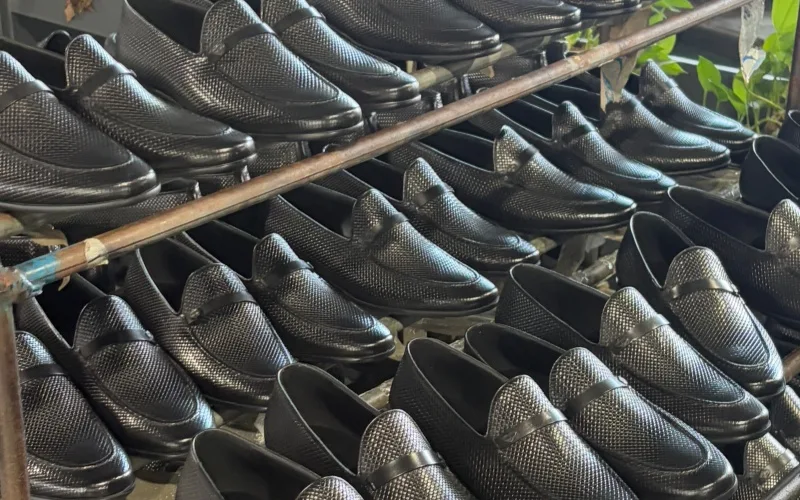
Verify Dress Shoe Supplier Lead Time and Production Capacity
Dress Shoe Supplier lead time depends on reference product approval, material readiness, production routing, quantity, packaging, season and the current schedule. Prompt for milestone dates and prerequisites instead of a single completion date. Dress Shoe Supplier production capacity should be tested with product-specific records, the current order mix, line planning and recent output; a broad headline figure does not establish available capacity for this program.
Commercial normalization for supplier comparison
| Comparison field | Required assumption | Buyer check |
| Order minimum | Binding material, setup, size, color or packaging constraint | Can the constraint be changed without weakening the range? |
| Unit price | Same specification, quantity, trade term and inspection scope | Are one-time charges separated? |
| Schedule | Approval, material, production and packing milestones | Are dependencies and available slots shown? |
| Capacity | Product route, current load and recent actual output | Is availability specific to this order? |
Award the Project through Conditional Approval
Score Evidence Gaps and Decision Conditions
A final score should distinguish confirmed strength, manageable condition and unresolved risk. Give greater weight to factors that can stop launch: category fit, purchase requirement control, material feasibility, reference product approval, quality evidence, schedule and accountability. A strong commercial offer should not erase a missing process owner or contradictory records.
- List every open assumption beside its owner and closure date.
- Convert material evidence gaps into pre-award or pre-bulk conditions.
- Reconfirm price and schedule after the specification is frozen.
- Keep an alternate supplier or recovery route for critical dependencies.
Conditional approval is useful when the supplier is suitable but a limited set of evidence remains open. The award note should say what is approved, what is prohibited, what must be closed before the next payment or release and who can accept the evidence. This makes the decision reversible until the most important risks are controlled.
Before final award, the buyer should run a scenario review for a dress-shoe sourcing route. Test a material delay, a failed sample criterion, a quantity change and a schedule conflict. For each case, identify the document that changes, the person who approves the response and the commercial consequence. Scenario review is valuable because it reveals whether the apparent control system works only when the plan is stable. A resilient supplier decision makes changes visible before they become undocumented substitutions, rushed approvals or disputed charges.
Before final award, the buyer should run a scenario review for a dress-shoe sourcing route. Test a material delay, a failed sample criterion, a quantity change and a schedule conflict. For each case, identify the document that changes, the person who approves the response and the commercial consequence. Scenario review is valuable because it reveals whether the apparent control system works only when the plan is stable. A resilient supplier decision makes changes visible before they become undocumented substitutions, rushed approvals or disputed charges.
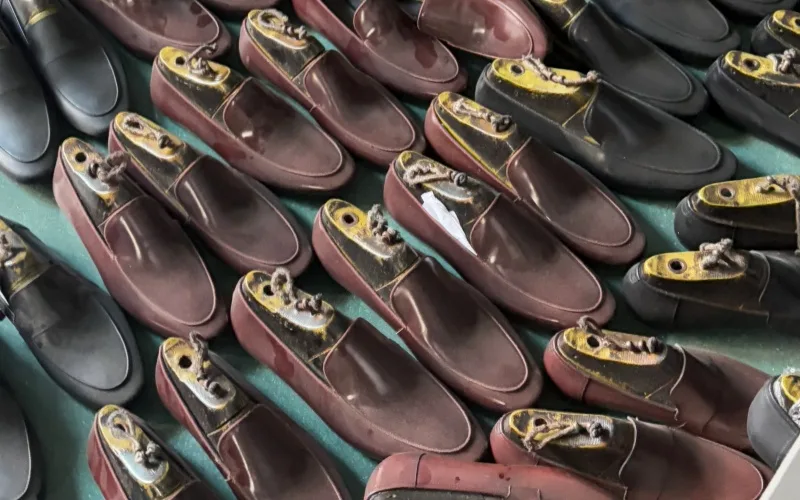
Frequently Asked Questions about Dress Shoe Supplier Decisions
How should buyers verify the factory behind a supplier?
Match legal identity, public address, a continuous view of production, current work orders, quality records and shipping evidence. One certificate or edited video is only one part of the verification chain.
What belongs in the RFQ?
State the style, construction, materials, size range, colors, branding, packaging, quantity, sales market, reference product status and requested schedule. Prompt suppliers to identify assumptions and exclusions rather than silently pricing an incomplete brief.
How do OEM and ODM responsibilities differ?
OEM normally starts with buyer-owned purchase requirements, while ODM includes more supplier-supported product development. Actual commercial routes can mix the models, so ownership, approvals, tooling and change control should be written into the brief.
What determines order minimums?
Order minimums depend on material purchasing, construction, color count, size mix, tooling, branding, packaging and production setup. A useful quotation explains the binding constraint instead of presenting one unexplained number.
What determines manufacturing lead time?
Timing depends on reference product approval, material readiness, construction, quantity, packaging, season and the current schedule. Prompt for milestone dates and dependencies, then reconfirm the plan after the purchase requirement is frozen.
Does final inspection remove every quality risk?
No. Commercial teams still need defined inspection coverage, measurable criteria, records, defect handling and corrective action. Quality control begins with the purchase requirement and continues through materials, production and packing.
How should production capacity be verified?
Prompt for product-specific records, line plans, the current order mix, schedule availability and recent actual output. A headline capacity figure is not enough to predict a particular program.
Turn the Dress Shoe Supplier Decision into a Controlled Project
The practical next step is to send one decision-ready package: the commercial brief, technical purchase requirement, approval matrix, quantity and size-color plan, required evidence, target schedule and quotation format. Prompt the supplier to clarify feasibility, assumptions, exclusions and open questions in writing. This creates a usable baseline for reference product development and later bulk release.
For Hengxin review, share the target collection, reference styles, construction, materials, sizes, colors, branding, packaging, quantities, sales market and schedule. The response should remain project-specific and evidence-led. The objective is not to force a quick yes; it is to determine whether the chosen counterparty model matches the buyer’s volume, development needs, control level and internal resources under a scope both parties can document and control.