
Cliquez ici pour afficher la table des matières
Table des matières
Approve a men’s dress shoe preproduction sample only for the features and variants it actually represents. First establish which specification, last, materials, size, colorway, and production method produced the pair. Compare the pair with the current controlled references; evaluate fit and paired appearance under defined conditions; and use separate evidence for properties the pair cannot reveal. Then record a release, a revision requiring another review, or a hold, with the decision’s exact scope. A visually convincing prototype is not automatically a production-ready reference, and one approved pair does not certify a whole production lot. BILLY Footwear’s supplier sample requirements show how one buyer distinguishes sample stages, while a sample approval guide describes the need to connect a sample with its specification and decision record.

What does this sample actually represent?
Its stage and actual components define what it can support. A pair made on the intended last with intended upper and bottom materials is more relevant to a production decision than a display pair made with convenient substitutes. But even a representative pair covers only its actual size, colorway, construction, and agreed test conditions. Name those boundaries before treating the sample as evidence of readiness.
How is a preproduction pair different from an earlier prototype?
A prototype can answer a design question, such as whether a toe shape looks balanced or whether a proposed closure can be assembled. A preproduction sample should be much closer to the pair the factory intends to make repeatedly: the chosen last, patterns, components, materials, tooling, and route should be sufficiently settled to test the production decision. A prototype that uses replacement leather may answer a silhouette question but cannot approve the production leather’s finish or behavior. The sample’s label is less important than the match between the actual pair and the production plan.
Different buyers use stage names differently. BILLY Footwear’s supplier instructions distinguish confirmation samples from top-of-production samples drawn from production. The useful question here is which decisions this physical pair can legitimately close. A confirmation pair made before final tooling may still leave production-process questions open. A top-of-production pair can reflect actual production, but it still needs to be judged against the right specification and cannot, alone, describe the whole lot.
Which size, colorway, and material substitutions narrow approval?
Any size, colorway, last, material, component, or production-route substitution narrows approval to the attributes actually represented by the pair. Identify the sample’s marked size and width, colorway, last, upper leather, lining, bottom components, and any substitute parts. If a brown sample was made with a temporary upper leather, its shape and some workmanship may be reviewable, while the specified leather’s color, hand, durability, and manufacturing behavior remain unresolved. That is a hypothetical distinction, not a report of a real order.
Likewise, one base-size pair cannot prove that every graded size has the same fit. A new last or a changed closure can make the tested size less representative of another variant. The buyer may approve a demonstrated attribute for the shown combination while keeping unshown combinations open, provided the decision record says exactly that. The footwear development overview on this site treats samples as decisions at different stages; for this approval task, the actual pair’s coverage must be more precise than the stage label.
How should the pair be compared with the approved specification?
Use the current style and revision as the baseline, then compare both physical shoes with its drawings, material list, last reference, artwork, and controlled color or finish samples. A pleasing difference is still a difference: the buyer must decide whether to correct the pair or deliberately revise the requirement. The comparison is useful only if the sample ID, colorway, size, and issue under review are unambiguous.
| Attribute | Compare with | What the pair can establish | Difference or missing evidence: next action |
|---|---|---|---|
| Identity and variant | Sample ID, current specification, colorway, and size | Only the represented combination | Unclear identity: hold until the pair is linked to the right issue. |
| Fit | Selected last and observed wearer or size conditions | Fit of the tested size under those conditions | Changed last or untested size: obtain fit evidence for the affected scope. |
| Paired appearance | Drawings and approved color or finish reference under matched conditions | Visible conformity of this pair | Disagreeing feature: remake the sample or intentionally revise the controlled requirement. |
| Material and finish | BOM identity, swatch, and relevant material evidence | Visible appearance, not material identity by sight alone | Missing identity or performance evidence: limit or hold the relevant claim. |
| Bottom construction | Chosen construction detail and applicable test route | Visible structural features | Wrong method or missing relevant result: resolve before releasing that feature. |
| Logo and pack-out | Controlled artwork, placement, and variant labels | Only the artwork and pack version actually shown | Unshown artwork or pack variant: keep it outside the approval scope. |
The table routes observations; it is not a completed inspection record. Project-specific acceptance criteria still govern the decision. A drawing locates a seam, a BOM identifies a leather, a swatch supports visual color comparison, and a fitting observation addresses a wearer’s experience. Their evidence cannot be interchanged just because it refers to the same pair.
What can paired visual inspection settle?
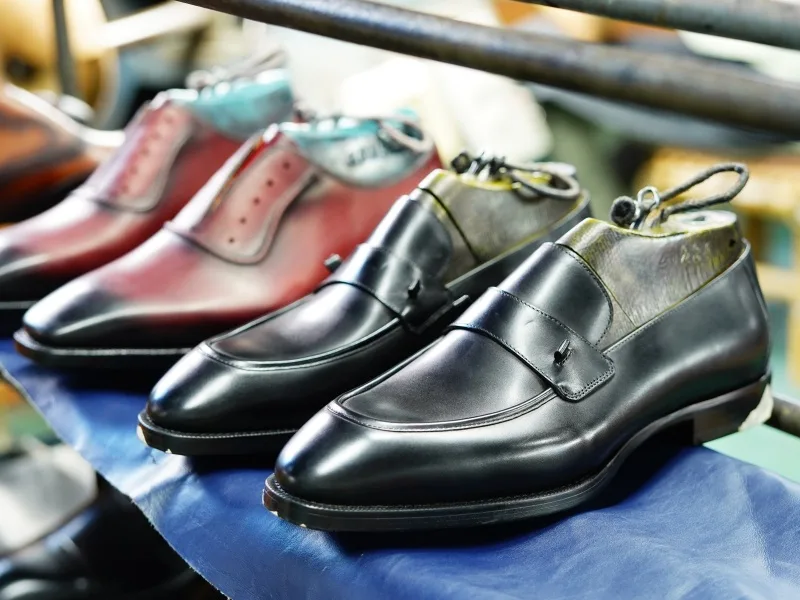
Compare the left and right shoe from matched front, side, and rear views. The front reveals toe and facing balance; the side shows seam placement, heel profile, and sole edge; the rear helps reveal heel and backstay alignment. Check logo position and visible finish against the current reference under the agreed observation conditions. The fact that two shoes look close does not supply a universal symmetry tolerance.
Using both shoes matters because a single photographed side can conceal a left-right discrepancy. Keeping the angle and light comparable matters because apparent color and texture can shift when one shoe is photographed or illuminated differently. A controlled swatch, approved sample, or agreed visual reference is more useful than a memory of the intended brown. The site’s development overview identifies sample review as a decision gate, but a pair-level review needs these concrete observation points.
What should happen when the sample and file disagree?
Identify the exact feature, the applicable requirement, and the scope of the discrepancy. If a quarter seam is in a different position from the controlled drawing, the team can remake the sample to the drawing or intentionally change the drawing and review the altered target. Quietly accepting the physical pair while leaving the drawing unchanged creates two competing standards. The same logic applies when a logo looks appealing in a new position: an aesthetic preference is not an automatic version change.
A seam position may affect appearance, pattern, and subsequent pairs; a material substitution may also affect hidden properties that visual review cannot settle. Where the consequence remains unknown, keep the item open rather than attaching a blanket approval to the whole shoe. Record the changed requirement and recheck affected references so the next sample has one baseline.
What fit evidence can a preproduction shoe provide?
A real pair can show how the selected last, upper materials, construction, and closure work together on a specified wearer in a specified size. A last shape is an important input, but it is not the same object as an assembled shoe, and a fitting result from one wearer is not proof for every wearer or size. The SATRA explanation of last and footwear fit supports treating the finished shoe and wearer interaction as a distinct assessment.
What do heel, instep, and forefoot observations tell you?
Look at heel retention, the amount and location of forefoot space, and how the closure behaves over the instep while the intended wearer stands and walks. These are different observations. Heel movement may be linked to rear shape or shoe hold; forefoot pressure may reflect available volume or upper behavior; a closure that cannot settle comfortably can signal a mismatch around the instep. None of these observations alone diagnoses a precise pattern correction. SATRA’s fitting assessment account describes checking toe allowance, fastening, heel slip, pressure, and instep characteristics while wearers walk.
Record the tested size, wearer characteristics relevant to the project, socks, and conditions so that another review can understand the result. A casual “fits well” from one person is a poor basis for releasing a whole range. A useful review connects the wearer observation with the selected last and sample identity, then asks whether the shoe’s actual material and construction match what production will use. SATRA’s fit discussion explains that final fit reflects more than the last alone. It still cannot guarantee fit for an untested population.
When does one fitted size fail to cover the range?
One successful base-size fitting covers the tested size and conditions. It does not automatically validate a smaller or larger size, a width variant, a changed last, or a new upper material. Graded patterns and materials can alter how the same design sits on different feet. The buyer should identify which sizes or variants have actually been tried and what additional fit evidence is needed for the rest before releasing that scope.
For example, if the sample uses the base size while the order will include a wider variant, record the base result and hold the wider variant’s fit decision until it is tested or otherwise supported by agreed evidence. Keeping these tasks distinct prevents the sample process from becoming an unsupported claim that “the range fits.”
Which claims need evidence beyond the physical pair?
The pair can reveal shape, visible workmanship, and some wearing behavior. It cannot by appearance alone establish material identity, durability, chemical compliance, bond performance, or production-lot consistency. Those claims need suitable documents or tests for the actual material, construction, market, and agreed requirements. A sample approval should state this evidence boundary instead of treating the pair as a universal certificate.
How should color and leather finish be compared fairly?
Compare the sample with a controlled color or finish reference under agreed observation conditions, checking corresponding areas on both shoes. Lighting and image display can change apparent color; a phone photo is useful for locating a concern, but may not be a reliable sole standard for a subtle shade or surface finish. A physical swatch or retained reference, identified by revision, can make the visual target repeatable. Even then, the buyer must distinguish the intended natural variation of the leather from a difference that breaches the project’s actual acceptance boundary.

Two panels may match in color while differing in material or finish behavior. Conversely, natural variation does not mean every visible mismatch is acceptable; the project needs a defined reference and decision rule. SATRA’s leather testing discussion illustrates why properties beyond visual impression may need separate methods. No universal color tolerance or leather grade is implied here.
Which construction or performance questions require separate tests?
If the claim concerns leather flex, finish durability, or another material property, use evidence for that material and claim rather than assuming the finished pair’s appearance proves it. If the claim concerns bottom attachment, select a method appropriate to the shoe’s actual construction. SATRA’s account of footwear sole bonding tests addresses relevant testing for bonded constructions; it should not be read as a blanket method for every stitched bottom. A test result also needs to be tied to the relevant materials and construction issue.
The target market and purchase specification determine which requirements matter and what pass levels apply. Even a passed test on a sample does not establish that the entire production run will be consistent. Production controls and later lot inspection address a different population of shoes. For the preproduction decision, the buyer should know which claims the pair itself supports, which reports support the remaining claims, and which are still open.
How should the buyer decide release, revise, or hold?
Release the defined variant only when its essential requirements have been met with suitable evidence. Revise when an intentional difference changes the controlled target and must be evaluated again. Hold when an important feature, fit question, material identity, test, or approval condition is unresolved. A vague “approved subject to checks” is not a full release if those checks could change the basic shoe or its allowed scope.
Which deviations require a new sample or specification issue?
First distinguish a departure from the specification from a deliberate change to the specification. If the sample has the wrong bottom construction, a different last, or a fit problem under the agreed conditions, correcting the pair and submitting a relevant new sample may be necessary. If the buyer wants to accept a changed aesthetic feature, the controlled drawing and reference must reflect that decision before subsequent pairs are judged against it. If the effect of a substitute leather is unknown, keep the affected material and performance claims open while other demonstrated attributes may be recorded separately.
The purchase specification and intended use establish which differences are critical. A cosmetic position change can still matter greatly when it affects a visible brand mark; a visually minor material substitution can matter when it alters durability or compliance. The useful record names the exact discrepancy, who must act, what new evidence would close it, and whether the rest of the pair can be considered independently. The sample approval guidance emphasizes linking decisions and deviations to a controlled reference rather than relying on an informal “OK.”
What exactly does the approval record authorize?
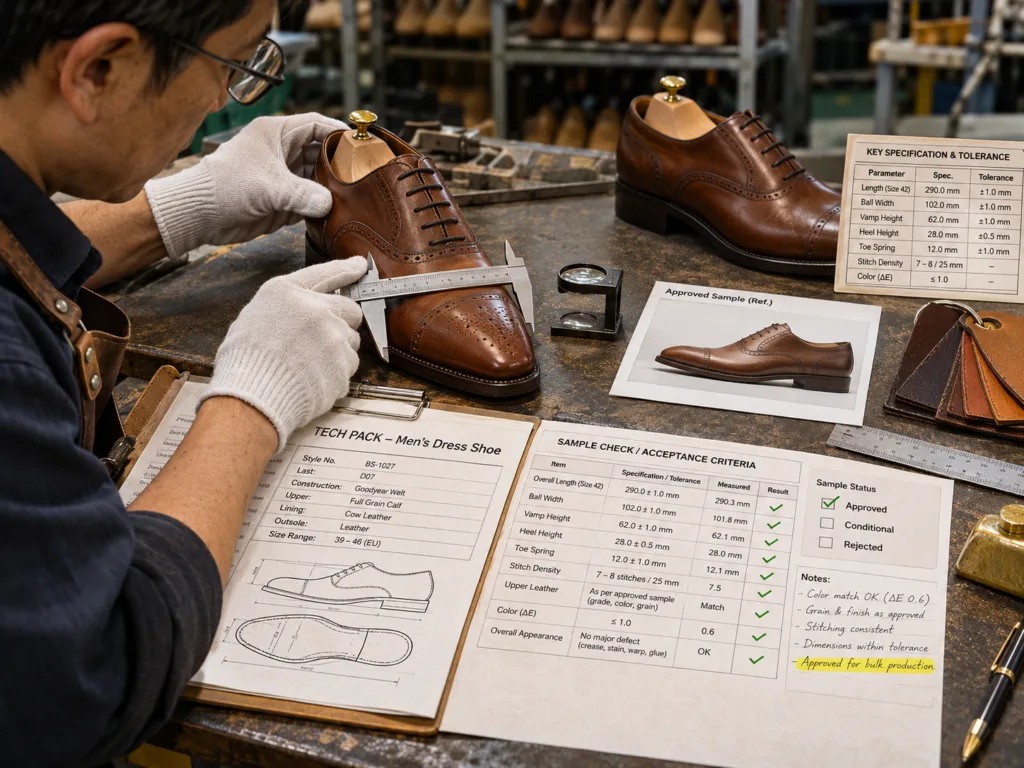
It should identify the physical pair by sample ID, date, style, size, width, and colorway, then name the specification, artwork, swatch, and test evidence used for the decision. It should state whether the decision is release, revision pending recheck, or hold, with any approved deviation and its scope. The authorized person and date belong on a real approval record; a draft article must not imply that such a person has already signed for this project.
Imagine one colorway has been examined while a second still awaits the correct upper leather. The buyer could record the first colorway’s supported decision and leave the second outside it. The actual record would need the project-specific identities and named decision owner; the example here explains scope, not a real sign-off. They must be able to tell which physical pair, file issue, and exceptions govern their work.
How is the approved pair used after release?
Keep the approved pair with its controlled references so production and later reviewers can compare against the intended target. The pair is a reference for shape, appearance, and the attributes it actually demonstrates. It is not a certificate that every produced shoe conforms, nor a replacement for material evidence or lot inspection.
What must remain traceable when production begins?
Record where the physical pair is held, which specification and variant it represents, and which swatch, photographs, measurements, and approved deviations accompany it. If two reference pairs exist for different colorways or revisions, distinguish them clearly. A later team should know whether a feature on the pair is the intended standard or an unresolved trial detail. If the approved requirement changes, the reference relationship must change deliberately too; retaining an old pair without marking its scope can create a misleading comparison.
The retained sample helps compare a new pair’s observable features with the approved target under similar conditions. It cannot establish the fraction of the whole order that conforms without an appropriate lot-inspection method, and a visual match does not prove a hidden test result.