Cliquez ici pour afficher la table des matières
Table des matières
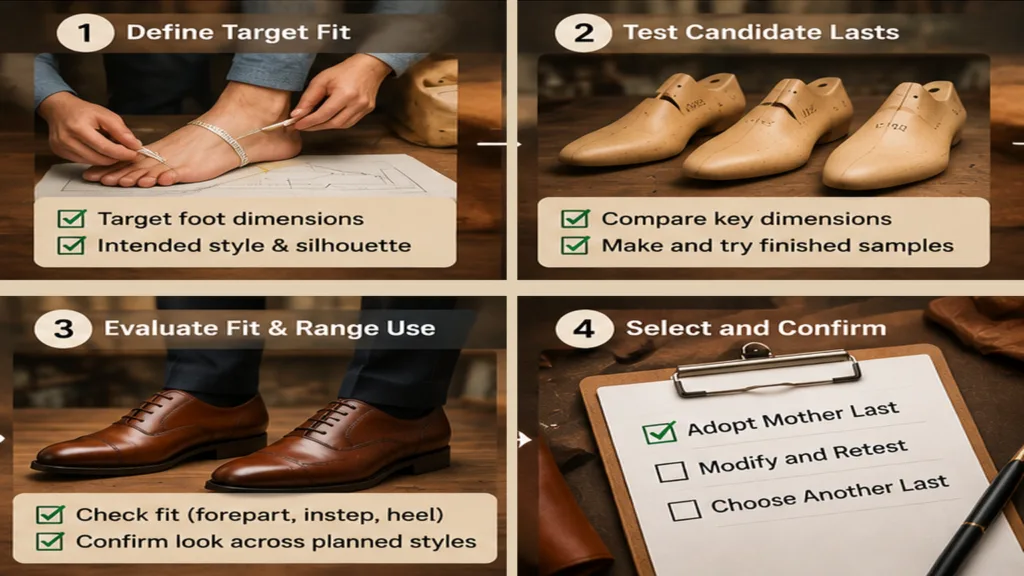
When a tester’s heel slips while the forefoot feels compressed in the same dress shoe, do not change the marked size first. Observe both symptoms in the same walking trial, locate where the foot and shoe move or press, compare the relevant foot, last and finished-shoe regions, and change the variable most consistent with those observations. Repeat the trial under the same conditions and check both zones. A larger size may increase forefoot room yet make heel hold worse, because these local interfaces do not necessarily change together.
How should the two symptoms be observed in one fit trial?
Watch the same wearer walk in the same sample pair, and record heel movement separately from the exact location and timing of forefoot pressure. “Too small” compresses two signals into one label and hides their possible causes. The relevant observation is not merely whether the wearer dislikes the shoe. It is whether the heel lifts relative to the backpart during a step, where the forefoot presses, and whether that pressure begins on standing, during walking or after the upper has settled. SATRA’s footwear fitting assessment includes wearing, fastening and walking observations rather than relying on an empty-shoe measurement alone.
For a B2B sample decision, identify the sample, wearer and affected foot. The left and right feet can differ, so record whether heel movement is vertical, forward or sideways and which foot has forepart pressure. Those details make a repeat trial comparable.
Which trial conditions must remain the same?
Keep wearer, sample size, sock thickness, fastening tension and walking sequence as consistent as possible when comparing a baseline and revised sample. Record the standing foot length and joint girth of both feet, because a loaded foot differs from an unloaded one and the two feet may not occupy a sample identically. SATRA describes foot measurement and whole-shoe measurement as related but distinct activities.
A small change in lacing can alter how the foot is held over the instep and can appear to improve heel retention without any last change. A thick sock can reduce local free space and increase forefoot pressure. A different walking distance can reveal a problem that a few steps did not. None of these observations makes the shoe defective by itself; they tell the developer whether a later comparison has held the conditions steady enough to interpret. If a condition changes unintentionally, repeat the comparison or describe the narrower conclusion that remains possible.
The wearer’s position in the intended foot group also matters. A person at the upper end of the target forefoot girth range can reveal a problem that another person will not. That does not make either report invalid. It means the team should know which feet the sample is intended to fit before treating one sensation as a range-wide verdict.
What should be recorded at the heel and forefoot?
Record heel lift during walking, the precise forefoot contact zone and the point in the step when pressure is felt. Also note whether the upper closes as intended and where it creases. Heel lift is shoe movement relative to the foot; forefoot pressure is contact at a location such as the ball, side or instep. Those are different observations even when the wearer reports them in one sentence.
At the rear, watch whether the foot heel rises out of the shoe as the shoe flexes. A heel that feels loose while standing may behave differently when the wearer walks. At the front, ask the wearer to point to the contact rather than choosing among vague labels such as narrow or short. A crease can help locate the bending region, but it is not by itself proof of excess or insufficient room. Note whether the complaint appears in one shoe or both and whether it changes when the fastening is reset to its original condition.
Why can heel slip and forefoot pressure occur in the same size?
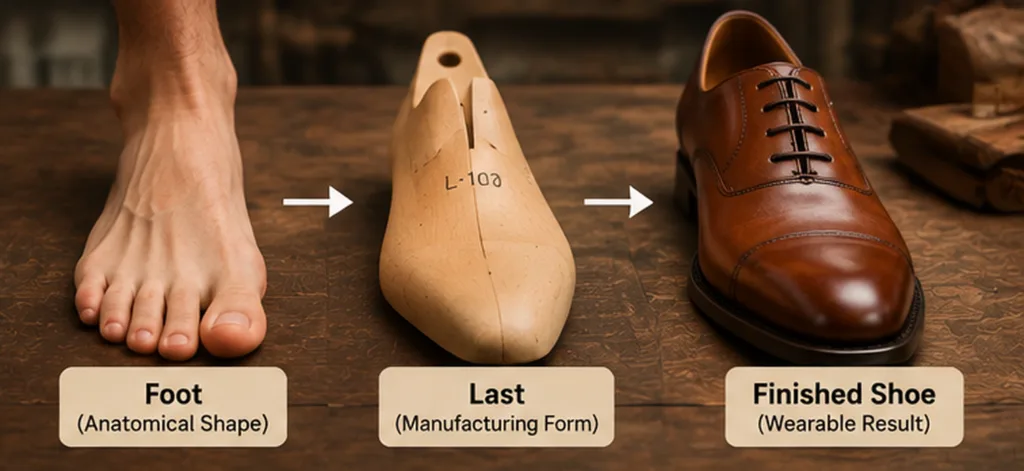
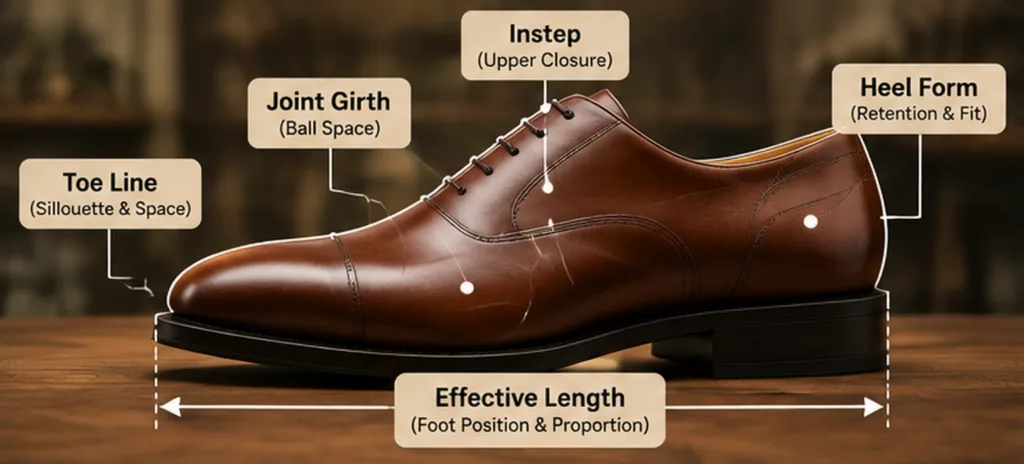
The marked size mainly communicates a length convention; heel retention, joint girth, instep volume, backpart height and closure are separate geometric constraints. A finished shoe can be loose at the rear and tight across the ball. Foot, last and finished shoe are also different shapes, so a number from one does not automatically describe the contact in another. SATRA’s measurement guide distinguishes these objects and their reference points.
Increasing overall length can move the heel farther from a holding surface while leaving a local forepart restriction unresolved. That is why “size up” is a hypothesis to test, not a diagnosis from the symptom pair. A second sample in another size can be informative if length measurements and toe position support it, but the developer should still observe what happens to the heel and forepart separately.
When does the backpart contribute to heel lift?
A backpart that is too low for the wearer and construction can allow the heel to lift during walking, although fastening and finished-shoe length can cause a similar observation. Measure the back height from a consistent insole-seat reference and watch the foot in motion before assigning the cause. SATRA notes that whole-shoe back height is a relevant measurement and that a low height may permit slip, while an excessively high topline can create rubbing.
The backpart is not a single magic dimension. Its contour, the upper’s hold around the heel and instep, and how the foot sits in the shoe act together. A lace-up that remains open too far may fail to hold the foot back even when the rear outline looks close. Conversely, tightening it simply to eliminate heel lift can create instep pressure and conceal a shape mismatch. Observe the original fastening condition, then use a controlled adjustment to learn whether closure affects the symptom; do not count that temporary adjustment as proof that a new last is unnecessary.
If the foot remains correctly positioned in the forepart but rises at the rear on each step, a local backpart trial may be more informative than a length change. If the entire foot moves forward and backward, examine internal length and closure as well. The observed movement tells the team which measurement to inspect first, not that every slip comes from the back height. A revised backpart must also be checked for rubbing, because stronger retention gained by a higher edge may create a different problem.
When does forefoot pressure point to local volume?
Forefoot pressure points to local volume when the contact is at the ball, side or instep while toe position and overall length remain plausible. Compare the wearer’s loaded joint girth and pressure location with the last region and the finished upper that surrounds it. A narrow-looking forepart is not enough to diagnose this; a width across one section and a girth around it convey different information. SATRA’s fitting discussion addresses the wearer’s foot characteristics and the sample’s local fit.
Upper pattern and material influence whether a nominally adequate last region yields usable space. A shoe can have sufficient decorative toe length yet compress the ball where the upper bends. An instep pressure complaint may instead involve closure shape or volume farther back. Locate the contact and inspect the upper where that foot region sits before proposing a forepart expansion.
A wearer near the larger end of the intended girth range may feel pressure that a smaller-footed colleague does not. This changes the interpretation: a one-person complaint might be outside the intended group, or it might expose a weakness near an important boundary of that group. The developer needs to know which case applies rather than dismiss the report or redesign from a single trial. The present task is to diagnose this sample’s paired symptoms; whether the range should offer a separate width is a later assortment decision.
Which sample change should be tried first?
Choose the first change from the strongest local evidence and alter one justified variable while keeping the rest of the trial comparable. A forepart pressure point with plausible length suggests testing local forepart or upper volume; observed heel lift linked to the backpart suggests a rear or closure trial. A size-label or length change belongs first only when the measured foot and finished-shoe lengths, toe position and movement support it. SATRA lists possible fitting modifications; the controlled one-variable order here is a development inference that makes their effects easier to read.
Use the table as a first-branch guide. Each row asks what would distinguish the plausible mechanism before a sample is revised; it is not a universal prescription or a numerical acceptance rule.
| Observed combination | Plausible local mechanism | First discriminating observation | Trial change and repeat signal |
|---|---|---|---|
| Heel slip and ball pressure | Rear hold and forepart space differ | Watch heel lift; locate ball contact and compare joint girth | Trial forepart volume if girth supports it, then a separate closure or backpart change for heel lift; retest both zones |
| Heel lift without front pressure | Back height, closure or overall length | Compare heel position while walking and fastening state | Trial the supported rear or length change; watch for new pressure |
| Forepart pressure without heel lift | Joint or instep volume restriction | Map the pressure against loaded foot and upper contact | Trial local volume or upper change; recheck heel hold |
An insert or insock change can move the foot relative to several contact zones at once; it is useful only if that movement tests a specific hypothesis. Asking a wearer to “break in” a sample does not explain an immediate pressure point or document the change that would be manufactured. If a proposed alteration affects two regions, note that possibility and read both outcomes in the repeat trial rather than calling the first improvement success.
When is a length or size-marking change justified?
Reconsider length or marking when loaded foot length, actual internal shoe length and toe position show a consistent mismatch. Heel slip with ball pressure alone is insufficient: a longer shoe may let the rear move more while the ball remains tight. Compare the same reference points across foot, last and finished sample, remembering that a last’s raw length is not the shoe’s usable internal length. SATRA explains separate foot, last and footwear measurements.
If the toes touch the front under normal seating and the heel is held in the intended position, a length hypothesis deserves a controlled sample. If the toes have adequate space but the pressure is at the ball, changing the length marking is less likely to address that local cause. A size stamp should reflect the chosen range convention and observed fit; it should not be changed simply to make a problematic sample appear to fit a different wearer. Any tested length change must be judged against heel hold as well as front clearance.
Do not confuse the label with the manufacturing geometry. Relabeling changes the customer’s expectation and the range’s size mapping; it does not change the physical sample. A revised last or different size sample changes geometry. Record which action was tested so that a later team does not mistake a label discussion for proof that the original shoe has been corrected.
When is a local backpart or forepart change preferable?
Prefer a local change when overall length is plausible and the symptom tracks a specific interface: heel lift with backpart or closure behavior, or forefoot pressure with ball, instep or upper contact. Trial the implicated region while holding the other sample variables as steady as possible. Then verify that the change has not created a new complaint in the other zone.
Suppose a hypothetical sample shows pressure at the ball, stable toe clearance and heel lift during the same walk. If a measured forepart restriction is supported by the wearer’s joint girth, a forepart adjustment can test that restriction. It does not automatically solve heel lift. A separate backpart or closure hypothesis remains, and a new sample must show whether the altered forepart changed the wearer’s position enough to affect rear retention. The example is a decision path, not a reported Hengxin result.
A local backpart revision can improve retention yet make the edge rub. A forepart volume change can ease pressure yet change how the upper holds the foot. That is why the team should prefer an alteration it can explain and observe, then compare both ends. If repeated local trials reveal that the underlying base last cannot meet the intended group and formal shape together, mother-last selection becomes the next task. This article does not turn one mixed complaint into a complete last-development guide.
How does the repeat trial show whether the change worked?
Repeat the same walk and fastening conditions with the revised sample, then compare heel movement and the original forefoot pressure location separately. Accept the direction of a change only if the targeted complaint improves without creating a material new problem in the other zone. The repeat test should identify the original sample, revised variable, wearer and conditions; otherwise an apparent improvement may reflect a different sock, lacing tension or walking pattern.
Use the same wearer first to isolate the effect of the changed sample. If the sample is intended for a wider foot group, assess other representative wearers after the local hypothesis has been tested, because one person cannot establish group fit. SATRA’s fitting assessment treats wear observations and modifications as part of the evaluation. The developer’s comparison should remain specific: how far did the heel move under the original and repeat walk, did the same pressure point recur, and did a new edge or instep contact appear? A sensation report and a visible movement can inform each other, but neither alone proves a particular geometric cause.
If the target symptom persists, revisit the causal hypothesis rather than making a second unrelated alteration and losing the comparison. If pressure eases but heel slip increases, the adjustment may have changed foot position or upper hold; it has not resolved the paired problem. If heel hold improves but the back edge rubs, the new interface requires a further local test. If both symptoms improve on a single wearer, repeat on the intended foot group before turning that trial into a range decision.
The outcome is a documented sample direction: retain the change, revise it or return to a different cause. A brand that has mapped the symptoms and tested one change can discuss the next sample with a manufacturing partner using that minimal record. It need not claim that a particular model or adjustment guarantees comfort, and it should not replace the diagnosis with a broad request for every possible last, material and order document.