Introduction : L'importance du savoir-faire artisanal dans la chaussure pour homme
Chez DressShoeFactory, nous sommes convaincus qu’une chaussure de qualité est un investissement — non seulement en matière de style, mais aussi de confort, de durabilité et de réputation. Conçues pour durer : les coulisses du processus de fabrication des chaussures haut de gamme Chaussures de ville en cuir C'est plus qu'un simple titre ; c'est notre promesse. Nous allons passer en revue les matériaux, les choix de conception, les techniques de fabrication (oui, la couture Goodyear) et les finitions qui transforment le cuir et le fil en chaussures que l'on est fier de porter. Surprenant, n'est-ce pas ? Ce sont ces petits détails — le liège dans la semelle intérieure, une forme soigneusement travaillée, un cirage à la main appliqué en plusieurs couches — qui permettent à une paire de chaussures de vieillir comme une belle histoire.
Nous sommes conscients de la tension qui existe entre la mode éphémère et l’artisanat traditionnel. On peut se procurer une paire de chaussures bon marché en quelques minutes ; en revanche, on ne peut pas obtenir en quelques minutes des décennies d’utilisation et une patine authentique. Si vous accordez de l’importance à la qualité et recherchez un fabricant qui allie production à grande échelle et savoir-faire artisanal, l’approche de Hengxin en matière de fabrication Goodyear et de patine peinte à la main offre des avantages concrets tant pour les marques que pour les consommateurs.
Les fondations : choisir les bons matériaux
Le cuir pleine fleur, référence du secteur
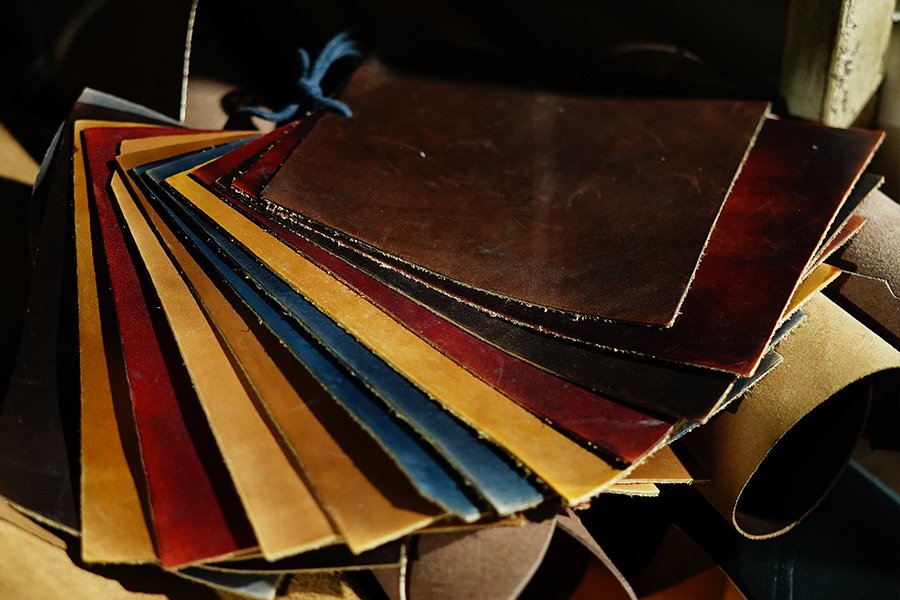
Cuir pleine fleur C'est le point de départ de nos gammes haut de gamme. Ce cuir conserve l'intégralité de la couche externe du grain, ce qui lui confère résistance, respirabilité et la capacité de développer une patine naturelle au fil du temps. Ce grain naturel — non poli ni corrigé — est ce qui rend le cuir à la fois durable et plein de caractère au fil des années.
Pourquoi nous choisissons le cuir pleine fleur :
- Résistance : les fibres les plus résistantes restent intactes.
- Respirabilité : meilleur échange d'humidité que les cuirs traités.
- Potentiel de patine : acquiert une belle profondeur avec l'usure.
Tableau de référence rapide — aperçu des catégories de cuir
| Note | Utilisation typique | Longévité | Meilleur pour |
| Pleine fleur | Robe et bottes haut de gamme | Très élevé | Des chaussures de cérémonie qui vieillissent |
| Cuir de première qualité | Gamme moyenne à supérieure | Haut | Des finitions lisses, moins d'imperfections |
| Corrigé/séparation des grains | Budget et mode | Modéré | Une apparence banale, peu de personnalité |
(Nous recommandons le cuir pleine fleur pour tout type de…) Chaussure habillée à trépointe Goodyear (conçu pour durer des années.)
Les éléments internes qui déterminent le confort et la stabilité
Le cuir apparent ne représente que la moitié de l'histoire. À l'intérieur de la chaussure, différentes couches et composants assurent l'ajustement, le maintien et le confort à long terme :
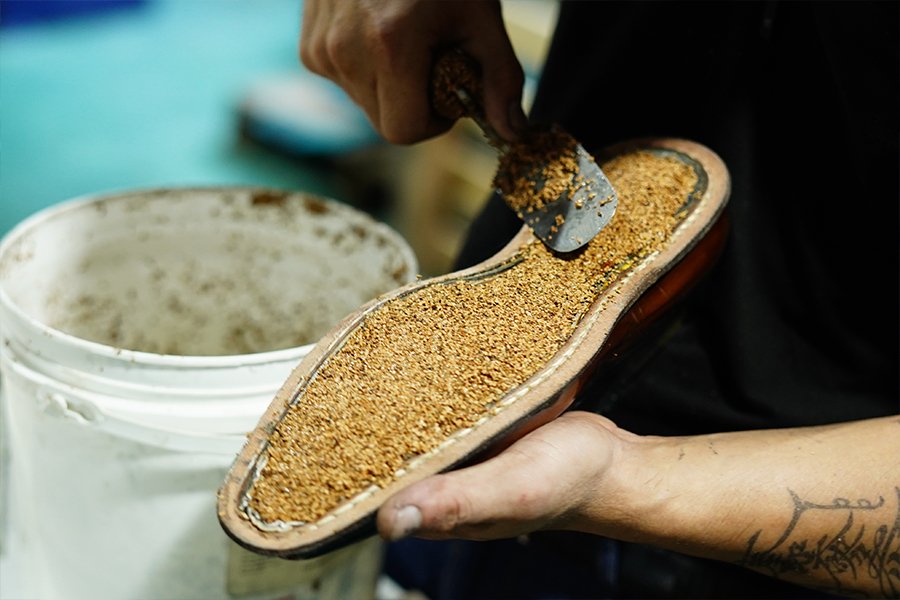
- Remplissage de liège — s'adapte à la forme du pied, offre un bon amorti et une bonne isolation. Au fil des mois, le liège se compacte pour former une semelle sur mesure qui améliore le maintien.
- Tige — un insert semi-rigide sous la voûte plantaire pour assurer un soutien en torsion ; en acier ou en matériau composite, selon les exigences en matière de poids et de souplesse.
- Doublures et semelles intérieures — Des doublures respirantes au niveau du mollet et une semelle intérieure en cuir épais ou en matériau composite garantissent un bon maintien sans compromettre le confort.
Liste de contrôle des composants (nos critères de sélection pour les chaussures de ville haut de gamme) :
- Cuir de dessus pleine fleur italien/français.
- Semelle intérieure en cuir dotée d'une rainure sur toute la longueur pour la couture de la trépointe (notre modèle standard).
- Rembourrage intermédiaire en liège, épousant la forme de la forme de chaussure.
- Tige en acier ou en matériau composite (selon le modèle).
- Semelles extérieures en cuir ou en cuir et caoutchouc, talons en cuir superposé.
De l'esquisse à la réalisation : conception et construction
Développer les derniers
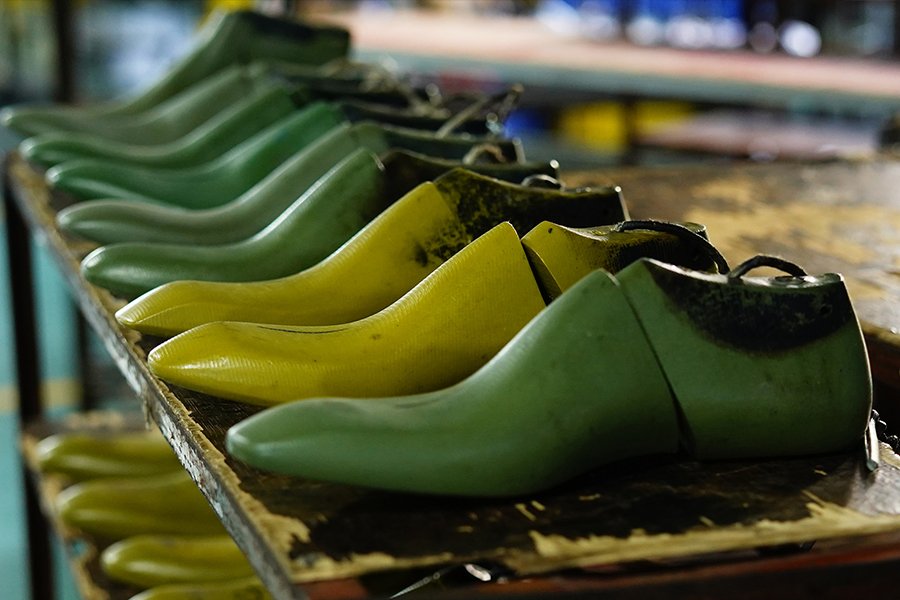
Vous êtes-vous déjà demandé pourquoi deux chaussures apparemment identiques peuvent donner une sensation complètement différente ? La réponse est le dernier — la forme tridimensionnelle qui détermine l’ajustement, la forme de la pointe et l’équilibre. Les formes sont mesurées et modélisées pour définir le cou-de-pied, le renfort de talon, la courbure de la pointe et bien d’autres éléments ; le choix de la bonne forme est le facteur déterminant par excellence du confort réel d’une chaussure. Nous modélisons les formes en CAO et à l’aide d’échantillons physiques, puis nous affinons notre conception grâce à des tests de port.
Formes : comparaison rapide
| Dernier type | Personnage | Best uses |
| Oxford last | Narrower, elegant toe | Formal Oxfords |
| Derby last | Roomier instep | Versatile / casual formal |
| Loafer last | Lower instep, flexible | Slip-ons & casual dress |
| Monk last | Slightly square toe | Chaussures de ville tendance |
Pattern Engineering and Cutting
Patterns are where aesthetic intention meets mechanical reality. We design for where leather will stretch, where seams will be under tension, and where reinforcement is required. Manual cutting remains important for small runs and special finishes; digital cutters help when precision at scale is needed.
Pattern engineering table — common decisions
| Design goal | Pattern choice | Pourquoi |
| Minimize stress at vamp | Longer vamp, reinforced quarters | Less stitching strain |
| Elegant toe profile | Narrow toe pattern + careful last selection | Shapes silhouette |
| Ease of resoling | Maintain full Goodyear channel | Facilitates repairability |
Assembling with Structure
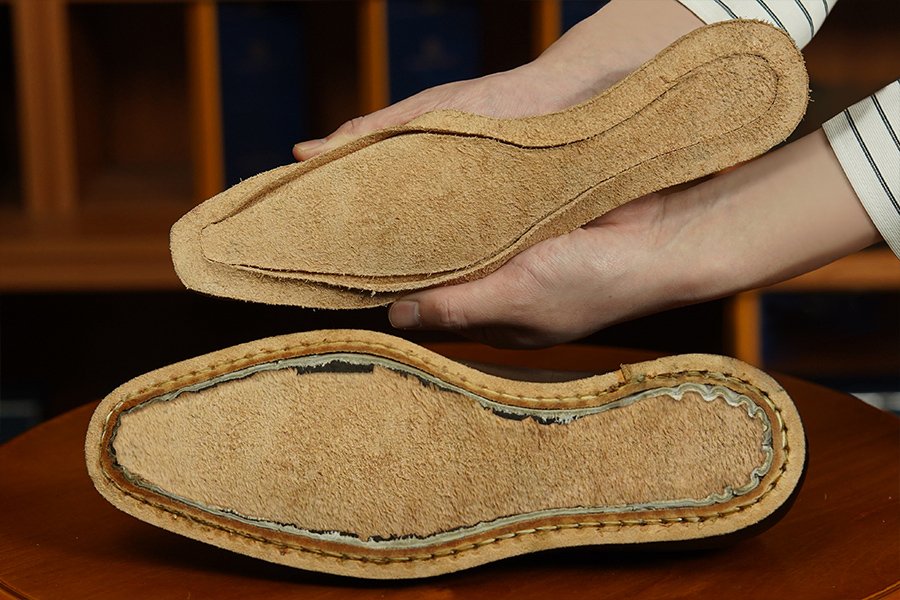
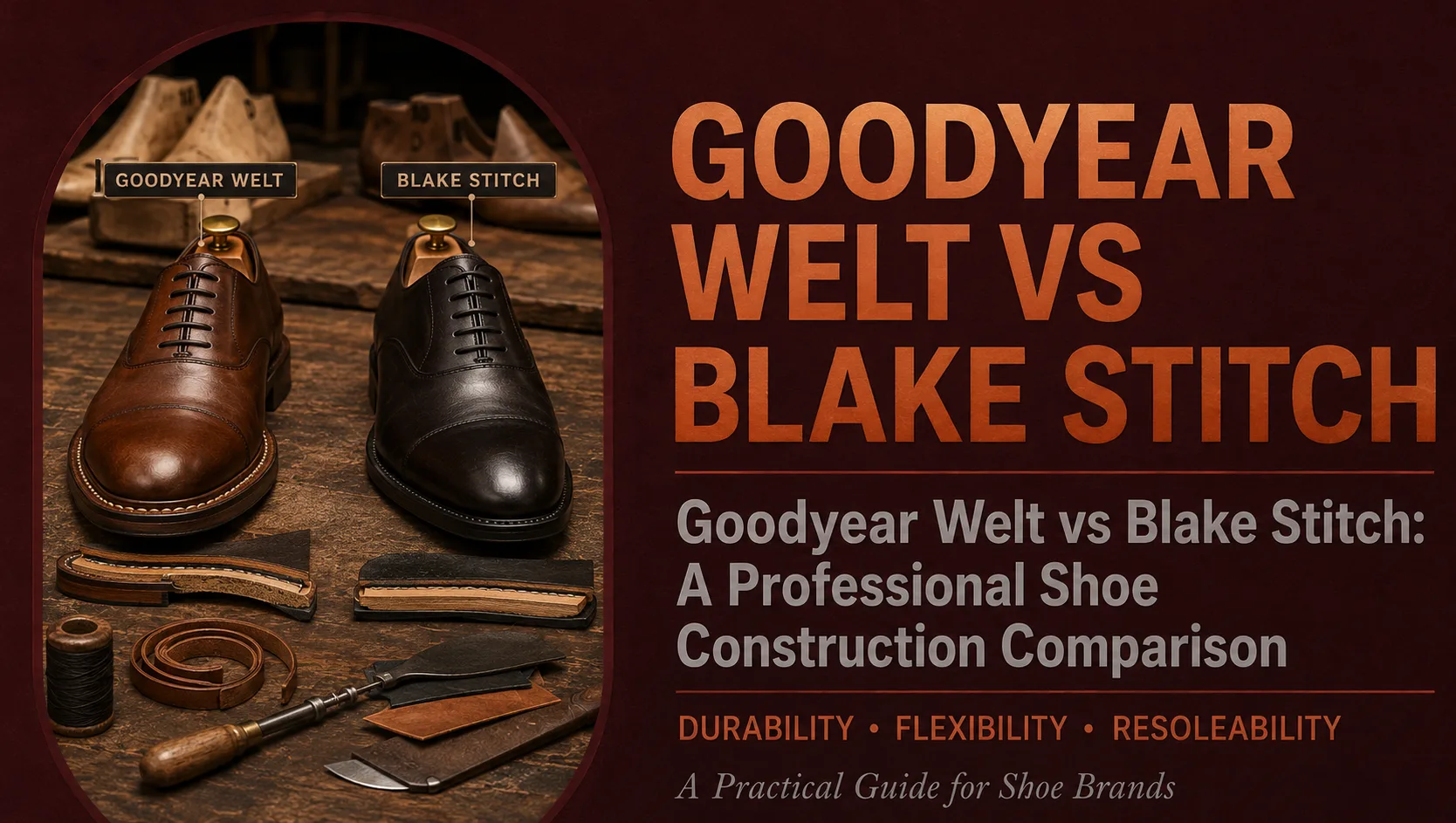
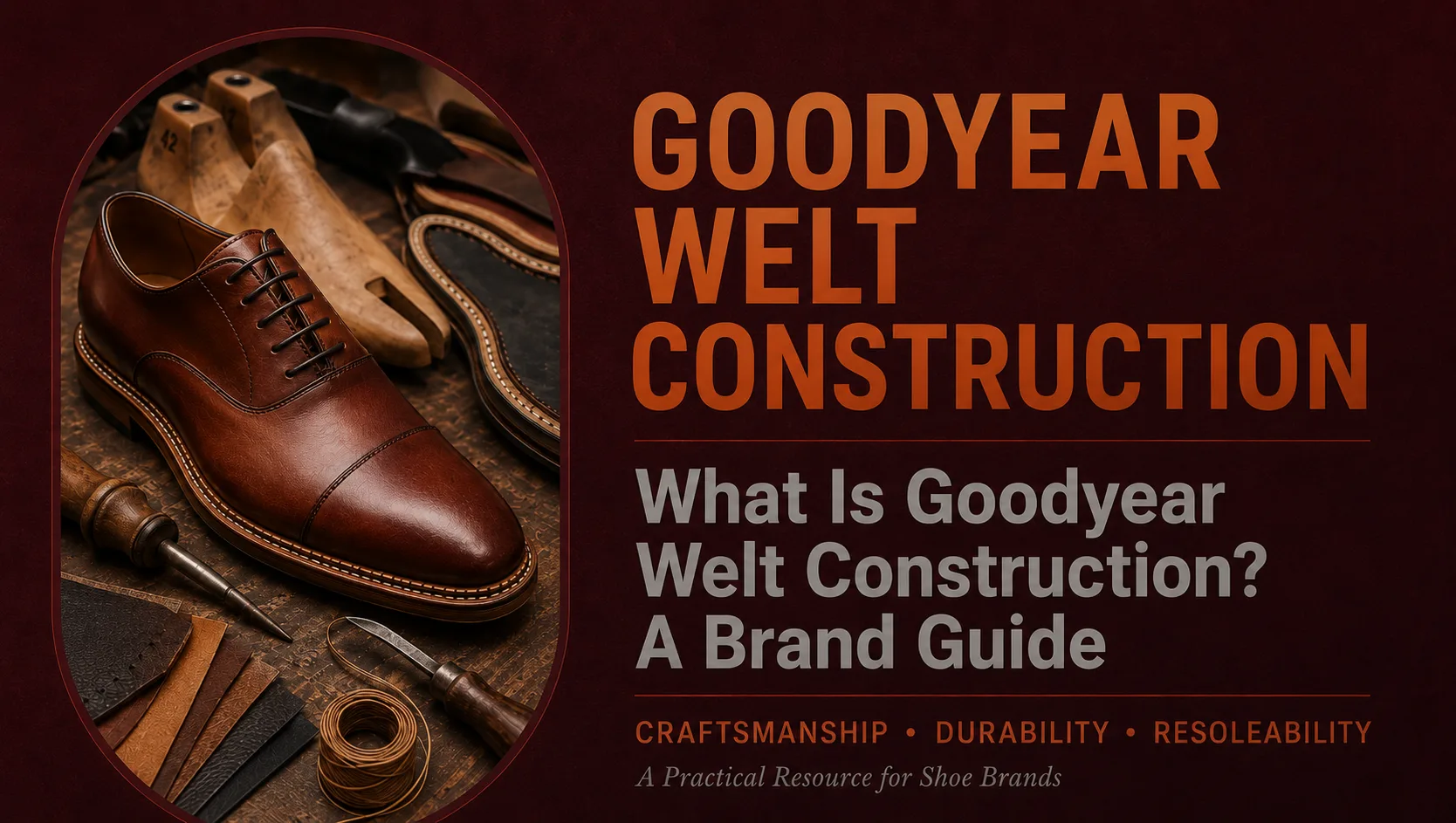
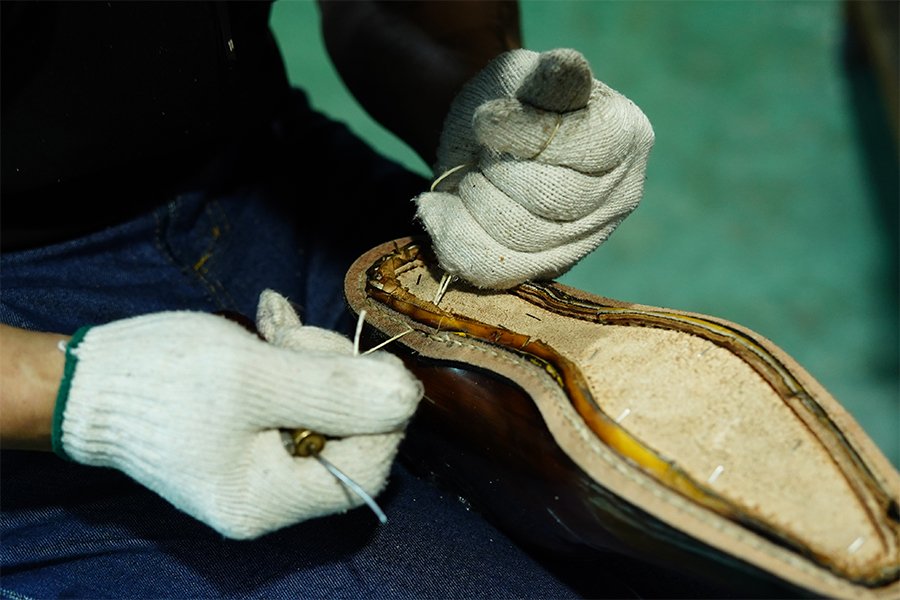
We use Goodyear welt construction across our premium lines — the method that makes resoling practical and predictable. But Hengxin has evolved that technique. Their 360° Channeling Insole welt — also described internally as “360° Goodyear Perseverance” — changes how the welt interacts with the insole and upper, creating measurable benefits:
- Leather channeling & suspension-bridge effect: In Hengxin’s approach the welt is stitched to a leather channel in the insole (a 360° channeling insole), which distributes tension and acts like a tiny suspension bridge across the bottom of the shoe. That improves flexibility while maintaining structure, so the shoe moves more naturally with the foot.
- Whole-day comfort & shorter break-in: The thicker, channelled insole adds stability and a controlled compressibility for the cork fill, which shortens the break-in period and gives more immediate comfort on first wear. This is a practical advantage for customers who need premium shoes that perform from day one.
- Sharper feather edge & cleaner silhouette: By stitching the welt to the insole sidewall rather than below the insole (as in many standard Goodyear constructions), Hengxin produces a crisper sole edge and a sleeker profile without sacrificing the Goodyear strength. This gives your brand a higher-end visual language while retaining serviceability.
- No seat piece & easier resoling: The 360° channeling sits flatter on the insole and avoids a traditional seat piece; that keeps the upper intact in the seat area and simplifies resoling with less disturbance to the upper — an advantage for warranty repairs and aftercare economics.
Construction process (numbered steps):
- Material selection (leather, lining, insole).
- Manual cutting & skiving.
- Assembling the upper, lasting over the last.
- Hand-drawing and stitching the welt into the 360° insole channel.
- Cork filling and contouring for the footbed.
- Outsole attachment and heel assembly.
- Sole edge finishing, burnishing, and polish.
The result is a Goodyear-welted shoe with clearer edges, better early comfort, and resoling simplicity — benefits that add up over the product lifecycle for both retailers and end customers.
Finishing and Inspection: Details That Define Excellence
Surface Finishing and Hand-Polishing
The difference between an OK shoe and a showstopper often lives in finishing. Techniques like burnishing, waxing, and layered color application create depth and visual life in leather. But Hengxin’s patine work is a level above what standardized factory dye houses produce.
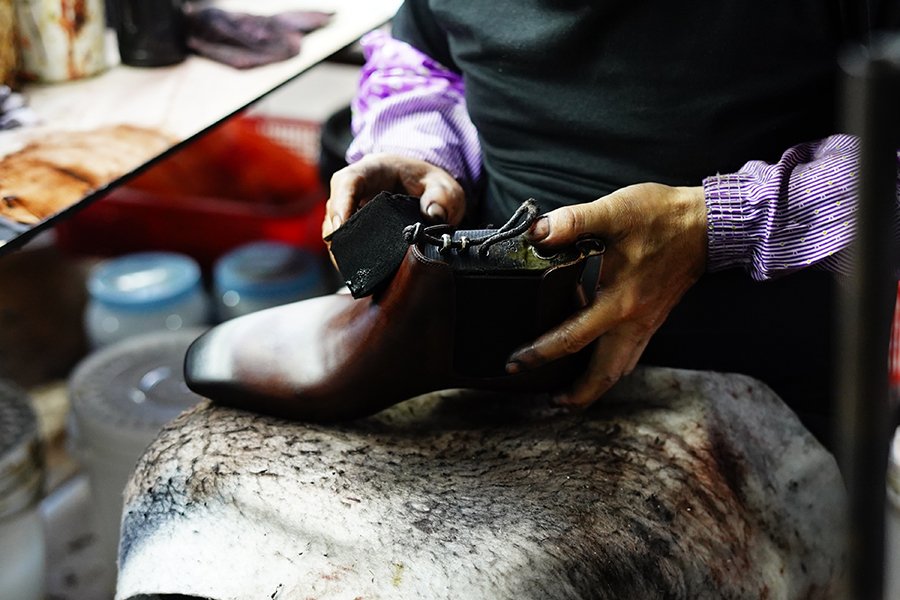
How Hengxin’s hand-painted patina differs from other manufacturers
- Artisan layering vs. single-pass finishing: Rather than spraying or dip-dying a uniform tone, Hengxin applies multiple hand-painted layers (brushed, washed, or pointillist techniques) to build depth slowly. This creates tonal complexity that changes interestingly with light.
- Localized modulation & accents: Skilled artisans selectively accent highs and lows — toe, quartes, vamp — to create subtle contrast and a “living” finish that evolves over time. Mass producers often aim for uniformity; Hengxin aims for character.
- Multiple stylistic methods: Their patina arsenal includes brushed patina, washed patina, and pointillist patina, each producing different aesthetic effects — from soft gradients to speckled depth — rather than a one-size-fits-all color.
- Precision and consistency at scale: While patina is an artisanal skill, Hengxin emphasizes processes and QC that ensure each pair meets a benchmark of tonal balance so that a bespoke look remains consistent across a production run. That positions their hand-painted patina between bespoke atelier finish and reproducible factory output.
Finishing checklist (typical multi-stage finish):
- Base dye + drying
- Layered color glazing / hand-painted passes (brushed/washed/pointillist).
- Edge sealing & burnishing
- Cream & wax polish pass
- Final aesthetic inspection
A small joke: if shoes could talk, they’d ask for a little cream now and then — and for a tasteful patina, the artist’s hand does most of the talking.
Quality Control and Testing
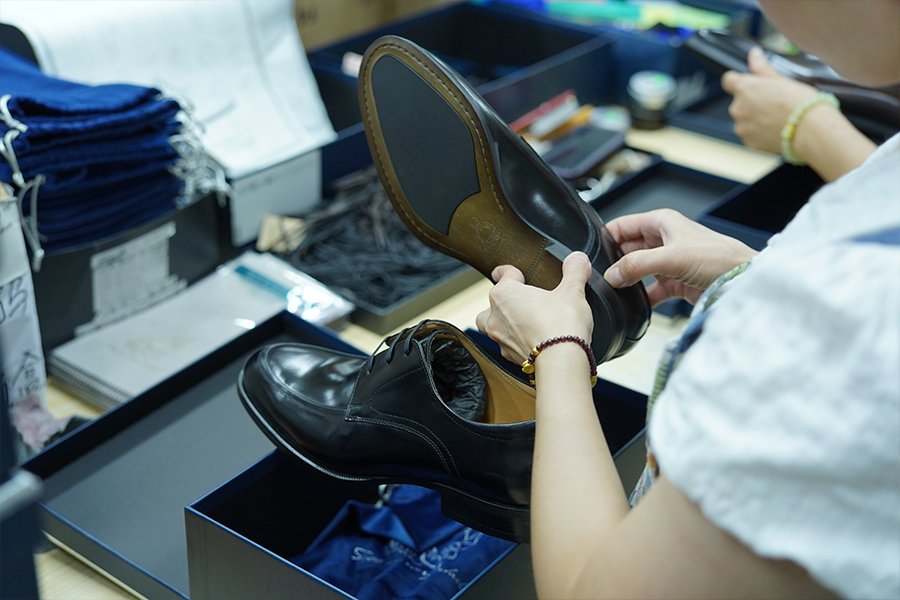
We run multi-stage inspections: fit checks, seam tensile tests, visual inspection for even patina and consistent edge finishing, and wear simulation where appropriate. For Hengxin’s 360° Goodyear channeling models, QC includes checking channel integrity, welt stitch density, and cork compression behavior after accelerated wear cycles. These steps make sure the innovations (comfort, resoling ease, sharper edges) perform in production — not just on paper.
QC steps (high level):
- In-process inspection at lasting & welt.
- Post-sole stitching inspection (stitch density, evenness).
Final aesthetic inspection (color, burnish, edge finish). - Pack & ship checklist to ensure safe transit.
Presentation and Packaging
Packaging should protect and present. Each pair gets tissue, a dust bag, and supportive packing. The unboxing is part of the product story — a small moment where quality confirms itself.
Why the Process Matters
A well-made shoe is not just a product — it’s a craft. Quality construction supports comfort, style, and longevity, while saving the wearer money (and wardrobe headaches) over time. A Goodyear-welted shoe with a well-executed insole channel and artisan patina costs more up front, yes; but resoling, repairability, and the evolving character of the leather deliver better lifetime value.
Manufacturers like Hengxin combine process innovation and handcraft so brands can offer premium Goodyear-welted footwear with hand-painted finishes that stand out in the market. Their 360° Channeling Insole welt improves comfort and resoling practicality, while their patina techniques deliver a look that mass-dyeing cannot match — a competitive differentiation for private-label or white-label partners.
Comparative table — quick lifecycle view
| Facteur | Mass cemented shoe | Premium 360° Goodyear + hand patina |
| Price (initial) | Faible | Plus élevé |
| Réparabilité | Faible | Haut |
| Comfort over time | Degrades | Improves (cork molds) |
| Visual evolution | Minime | Develops rich patina |
| Brand differentiation | Limitée | Haut |
Balanced viewpoint: some modern constructions are lighter and cheaper to produce, and they suit certain price-sensitive markets. But for customers who value repairability, early comfort, and a distinct visual signature, the combination of Hengxin’s 360° Goodyear channeling and hand-painted patina is compelling.
FAQ
What is Goodyear welt construction, and why is it better?
A leather welt is sewn to the upper and insole rib, and the outsole is later stitched to that welt. Hengxin’s 360° Channeling Insole welt is a refined variant: the welt is stitched into a leather channel in the insole, producing improved flexibility (suspension-bridge effect), a sharper feather edge, shorter break-in, and easier resoling. That combination gives you durability plus a better early-wear experience.
What type of leather is best for formal shoes?
Full-grain leather is the gold standard for durability and patina potential; top-grain gives a smoother, more uniform appearance. We typically source premium hides and specify full-grain for dress lines that will be hand-finished.
What are the key components inside a quality dress shoe?
A leather upper, leather insole, cork filling, shank, and a welted outsole are core components. Each contributes to fit, comfort, and serviceability. Hengxin’s process emphasizes cork filling and a full insole channel for predictable results.
How is hand-painted patina different from other manufacturers?
Hand-painted patina uses skilled artisans applying multiple, localized layers and techniques (brushed, washed, pointillist) to build depth and tonal complexity. Mass finishes tend to aim for uniformity through automated spraying or dipping. Hengxin strikes a balance between atelier-level aesthetic and factory-scale consistency by combining handwork with process controls and QC.
What should I look for when buying well-made men’s shoes?
Look for full-grain leather, evidence of welt construction (or clear documentation of it), even stitching, a comfortable last, and the ability to resole. Ask about insole construction (cork fill and a full insole channel are positive signs) and about the factory’s patina and QC processes.
Final Thoughts & Call to Action
Finished with care, the shoes stood proud. If you value longevity, character, and the sensible economics of repair over replace — invest in craftsmanship. If you’re a brand or retailer looking to bring premium Goodyear-welted footwear with hand-painted patina to market, compare lasts, materials, and QC protocols before you sign on the dotted line. We’d love to show you how our 360° channeling Goodyear welt approach, refined cork filling, and artisan patina options can deliver exceptional product to your customers. Learn more about our Goodyear welt process and our patina options, or request a factory quote today.
A memorable final thought: quality is quiet work — but it’s the thing people notice without knowing why. Ready to make shoes that speak for themselves?