Clicca per espandere l'indice
Indice
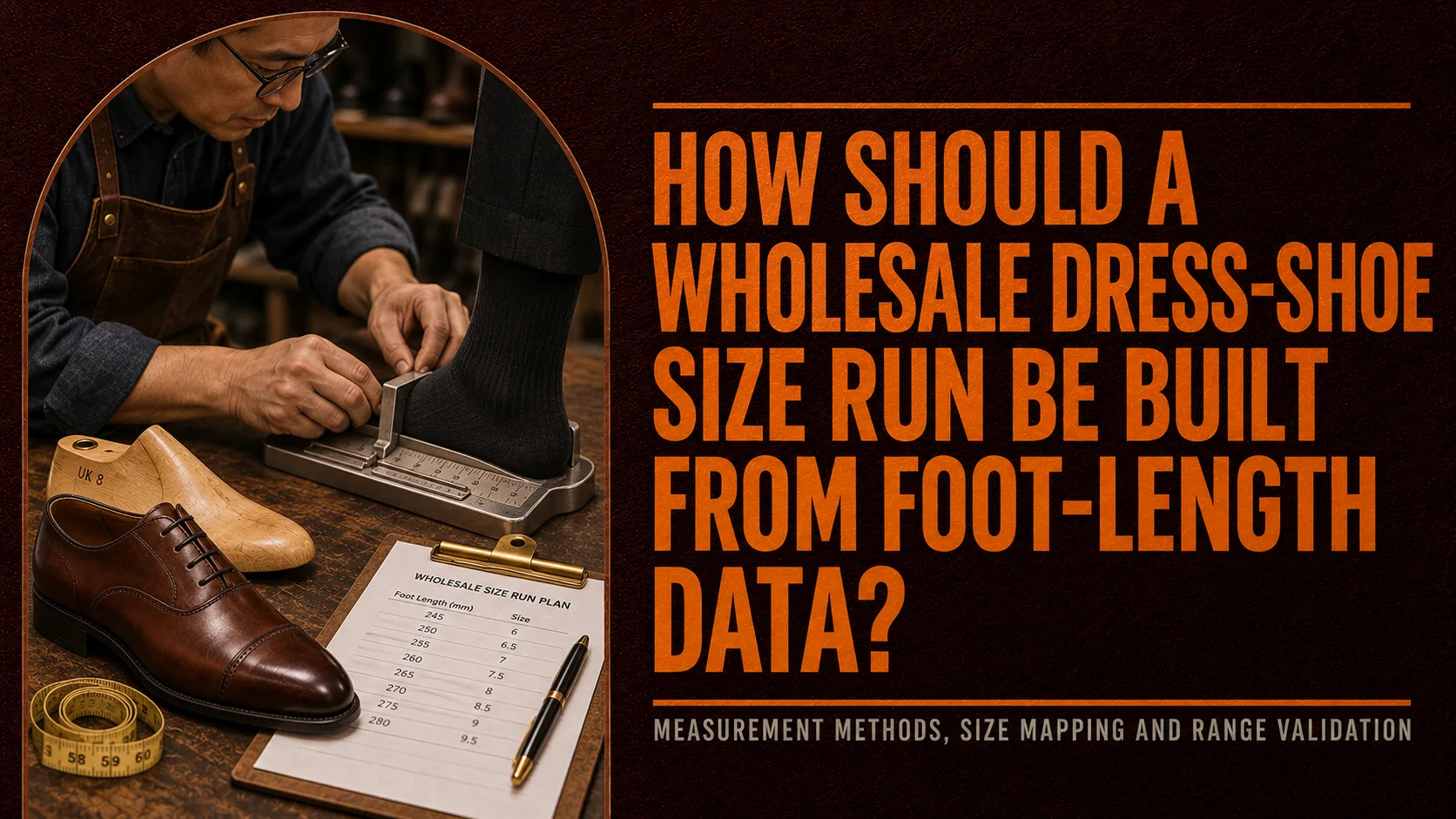
A wholesale dress-shoe size run should start with standing measurements of both feet from the people the range is intended to serve. Map the resulting length distribution to the target market’s size system, propose central and boundary markings, and then test those markings in the actual shoe. A conversion chart can help name a size; it cannot show that the last and finished shoe will fit. The useful output is therefore a proposed list of orderable labels with a stated measurement basis and a trial decision for its endpoints, not a row copied from a UK–US chart.
Which foot measurements can support a size range?
Use consistently collected, weight-bearing measurements of both feet, together with a description of the people measured. The measurements must show the spread of lengths, especially near the tentative ends of the range. One person’s foot, one average, or a list of previously sold labels cannot establish which customers the new range will cover.
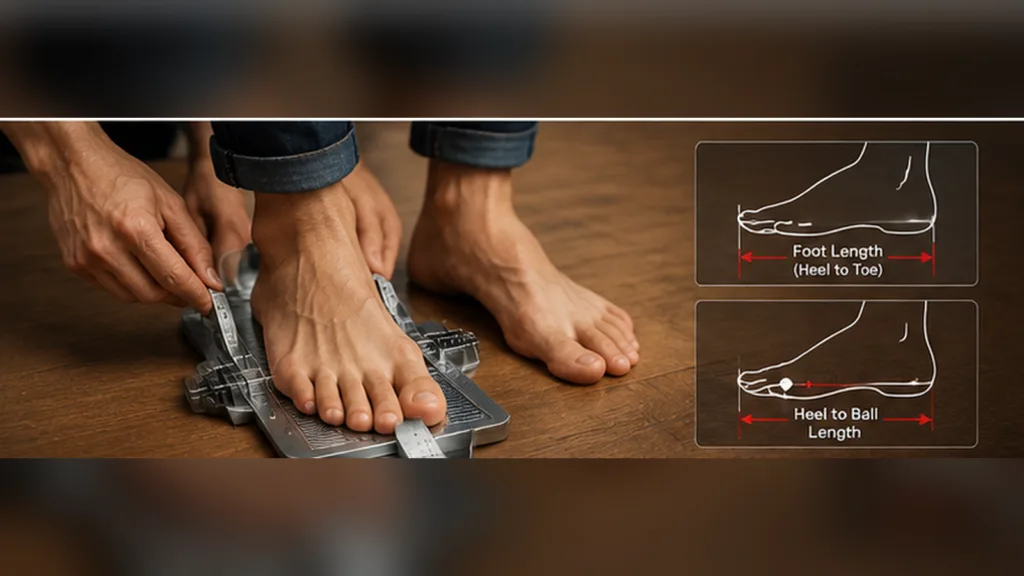
A bare length value is meaningful only with its measurement method. Standing places weight on the foot and can change its dimensions from a seated reading. A device, floor mark, or digital method should be used in the same way for everyone, with a common unit and a defined heel and toe reference. Record the conditions rather than mixing values taken while seated, standing, wearing thick socks, or using different endpoint conventions. Brannock’s fitting instructions show why both feet and heel-to-ball information matter to shoe fitting. Their device’s size reading is still a fitting input, not a specification for every manufacturer’s shoe.
How should two feet and different measurement conditions be handled?
Measure each foot under the same standing conditions and retain the two readings. Where one foot is longer, that difference can decide whether a proposed endpoint or intermediate marking deserves a trial; silently averaging the feet can hide it. The larger reading is often the practical starting point for length selection, but a person still needs to try the finished shoe on both feet, because volume and shape can differ as well.
Heel-to-ball position adds another check on what a length figure means. Two feet can have a similar heel-to-toe length while their joints sit at different positions relative to the shoe’s flex area. That does not create a second, independent size range by itself. It means a length-derived label should be treated as a starting hypothesis when the actual shoe is assessed. The brand should keep the length and heel-to-ball readings distinct instead of converting the latter into an invented universal offset.
If measurements come from stores or distributors, use one method and identify the customer segment represented. Combining incompatible readings can create a false boundary.
What does the target customer distribution add beyond an average?
It shows where people sit relative to candidate size boundaries. An average identifies a centre, but it does not show whether the tails are short, long, or uneven. Two groups could have the same mean length while one has many more people near a proposed upper endpoint. A wholesale range built for those groups might need different outer markings, even though the mean is identical.
The buyer should decide the coverage aim before deciding the extremes. An assortment intended for a defined wholesale account may seek coverage of that account’s measured customer population, whereas a broad launch may need a more cautious, testable initial span. This is a planning choice, not a universal statistical cutoff. For illustration, imagine two hypothetical datasets with the same central length: one is tightly grouped and the other has a longer high-end tail. Adding a high label to the second proposal could be reasonable, but only if the intended marking system and a usable shoe sample support that extension. The example describes decision logic; it is not a claim about Hengxin customers or actual sales.
Preserve measured length intervals rather than only the most common size name. Treat a sparsely represented endpoint as provisional until a trial supports it.
How do foot lengths become proposed size markings?
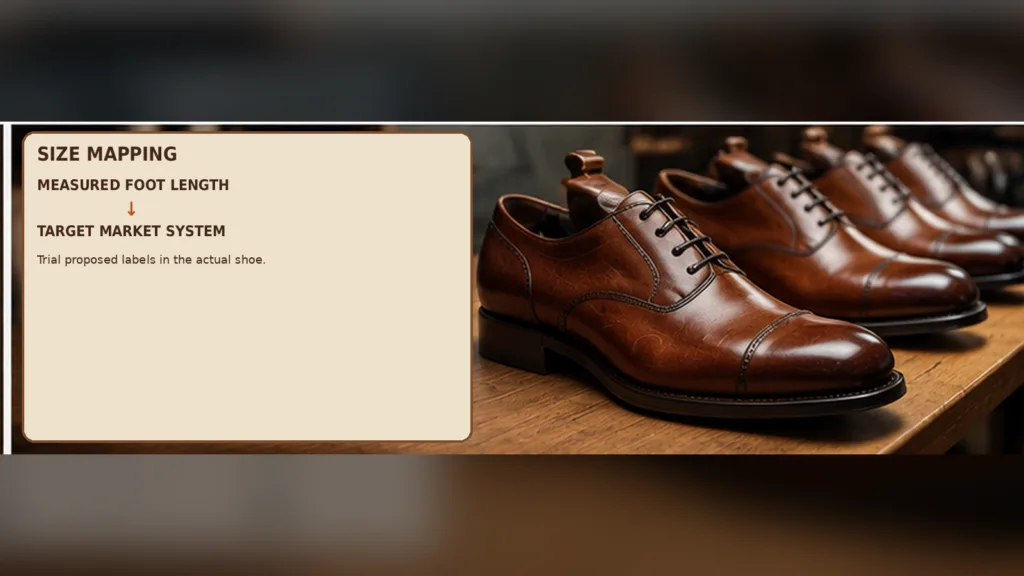
First select the intended market’s marking system, then use its published length guidance to propose labels for the measured intervals. Keep the physical lengths, the proposed labels, and the shoe samples in separate fields. The mapping creates an orderable draft, while uncertainty at boundaries and half-size positions remains visible until trial.
ISO 19407:2023 describes a conversion system based on foot length and presents conversion tables as guidance. That public description supports a length-based starting point; it does not give a universal fit guarantee or license to invent numbers from a table that has not been read. In practice, a buyer needs the actual market convention used by its customers, the mark intended on the shoe or box, and a consistent way to resolve between-mark positions.
| Input | Transformation | Provisional range output | What a trial can overturn |
|---|---|---|---|
| Standing left and right lengths | Retain separate readings under one method | Comparable individual length records | An inconsistent posture or endpoint requires remeasurement |
| Target-group length spread | Locate centre and tentative edges | Candidate lower, central and upper positions | Boundary wearers may expose a missing or unnecessary edge |
| Intended market’s marking guide | Map length intervals to offered labels | Draft labels, including a half size only if available | A label does not establish fit in the chosen shoe |
| Central and edge shoe samples | Compare feet with the actual marked shoes | Accepted or revised size-run specification | Record the last and shoe reference behind the decision |
Keep the original length readings beside the approved labels so a disputed trial can be traced to measurement, mapping or the shoe itself.
Why can two published size systems disagree at the same foot length?
They use different marking conventions and increments, so a particular physical length does not necessarily land on labels that have a neat fixed offset. A UK label and a US label may appear close in one part of a chart without making a blanket “add one” rule valid at every boundary, half size, or product. A conversion is a relation between naming systems; it is not a physical change to the foot or shoe.
Start from the system the intended customer will actually encounter. If a buyer supplies both UK and US markings, identify which is the governing development reference and how the second label is derived. Avoid independently rounding each system from a different chart and then treating the resulting pair as equivalent. When a measured foot falls near a boundary, record both plausible candidate marks for trial rather than concealing the ambiguity. A boundary may turn out to be a shoe-fit question rather than a conversion error.
The marking system may offer half sizes that the available last family does not. A chart’s granularity cannot create a physical shoe; the offered shoe and printed mark must agree.
When should a half size be included rather than rounded away?
Include a half size when it is supported by the intended marking system, can be made on a distinct and suitable last or size progression, and resolves a repeated fit gap between adjacent samples for the target group. A half mark is useful only if a wearer gets a meaningful alternative; printing an intermediate label on an unchanged shoe would not create one.
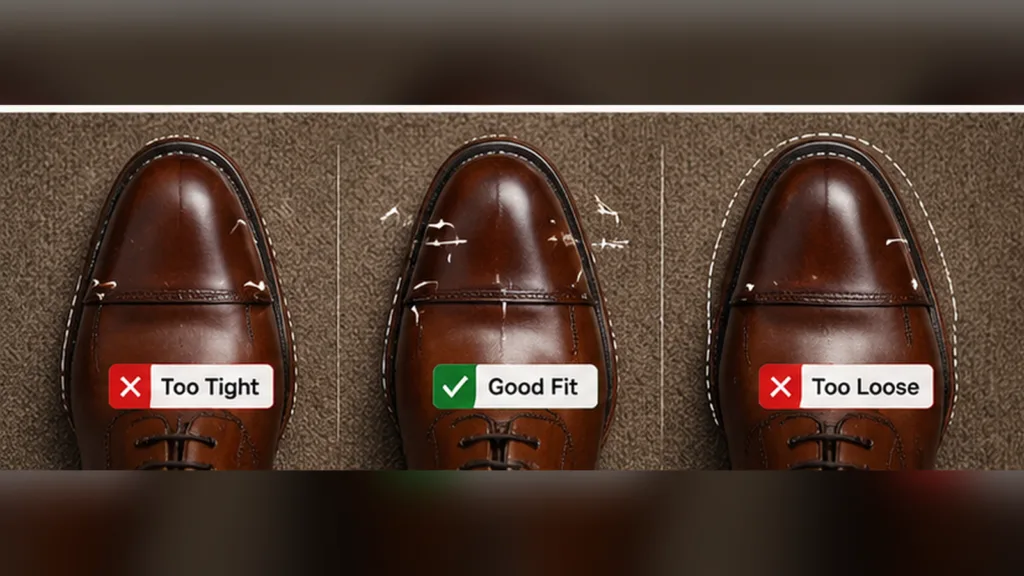
Look at the measured intervals around the two whole-size candidates, then trial wearers whose lengths fall near the dividing region. If one whole size repeatedly feels too short while the next repeatedly creates excess movement, an intermediate sample is worth testing. The observation must be interpreted in the same shoe and construction. A tight instep or slipping heel might instead point to a volume issue, and changing only the length label would misdiagnose it. The wider choice of fit options belongs to the separate width-range decision.
No universal share of customers proves that every market needs half sizes throughout the entire range. An intermediate mark near the centre may matter more than one at a sparsely represented edge; in another population the reverse may be true. Record the reason for each proposed half size, including the length interval it is meant to serve and the outcome the shoe trial should demonstrate. This makes the choice revisable if the target group changes.
Why is a converted size still not a fit decision?
A converted label names a nominal size; fit comes from the relationship among the foot, the last, the upper and the finished shoe. Shoes bearing the same label can differ in local space and movement, so the proposed run must be checked in the actual style and construction. SATRA’s discussion of measuring feet, lasts and footwear treats those as related but different objects.
The difference is practical for wholesale approval. The buyer is not merely approving a range of printed numbers. It is approving the particular size progression produced from a particular last family and realised in particular shoes. If those references change, an earlier trial of labels alone may no longer answer the same question.
Which shoe features can change fit without changing the printed size?
The forepart’s width and shape, instep space, heel containment, upper and closure can change how a foot sits inside a shoe marked with the same length size. For example, a wearer can have enough toe-end length yet feel pressure across the joints. Choosing a longer nominal size may relieve one pressure while leaving too much heel movement. That is a local-space problem, not evidence that the original length measurement was false.
The last is a three-dimensional form, while a size chart is mainly a naming relationship. The finished shoe adds material and construction effects to that form. A shape that appears roomy at one region does not automatically gain space everywhere. This is why a fit trial should record where pressure or movement occurs instead of collapsing every observation into “too small” or “too large.” The buyer need not design the mother last within this size-run decision, but should identify which last family and shoe sample each tested label came from.
The heel-to-ball relation also helps interpret a complaint at a nominally correct length. If the foot’s joint position and the shoe’s flex region disagree, an end-to-end length conversion may look right while walking feels wrong. That finding should trigger a closer fit assessment; it does not justify shifting every size label by an arbitrary amount. This distinction protects the range from a correction that treats a local mismatch as a systematic conversion fault.
What should the buyer infer from disagreement between chart and trial?
Separate three possible causes: an inconsistent foot measurement, an unsuitable mapping to the selected market label, and a shoe-fit mismatch despite a defensible label. Repeat the measurement under the agreed method, check the proposed mark against the chosen system, and then compare the actual foot and shoe where the trial fails. The next action depends on which relation breaks.
If several wearers at neighbouring measured lengths show the same shift in the same shoe progression, the proposed marking or size progression may need revision. If one wearer reports a local pinch while others at similar length fit, assess local geometry before rewriting the entire range. If a single edge size fails, test whether extending the range, revising that shoe size, or changing the intended coverage better addresses the gap. These are different decisions with different consequences. Treat a trial as evidence about a named sample and group, not a vote that a chart is globally right or wrong.
How should the proposed range be confirmed before a wholesale order?
Try central and tentative boundary sizes in the intended shoe on people representing the target length intervals. Compare their recorded foot dimensions with pressure, movement and walking observations, then approve, extend, narrow or revise the labels and shoe references according to where coverage fails. This makes the range an accountable specification rather than an inherited chart row.
A useful trial does not require pretending that one fixed sample count or acceptance threshold applies to every collection. It does require a clear question for each sample. SATRA’s footwear fitting assessment description supports evaluating shoes on wearers rather than accepting labels alone. The buyer should document the intended wearer group, the style and construction used, the last reference, the marked size, and what was observed at the foot. Those details allow a later change to be traced to its actual cause.
Which sizes reveal coverage errors most efficiently?
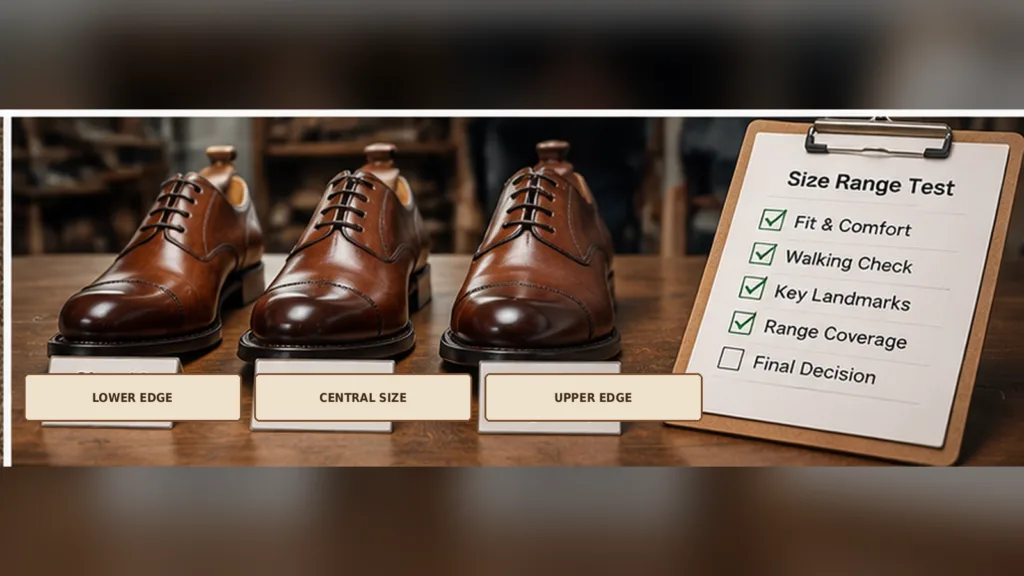
Test the central sizes where the target group is concentrated and the low and high sizes that define the proposed offer. Central trials show whether the basic mapping works in common cases; boundary trials show whether the range really reaches the people at its edges. Where half sizes are proposed to bridge a repeated interval, trial those transitions as well. These positions answer different questions and should not be replaced by several wearers all trying one convenient middle sample.
Select people by measured foot interval, not only by the size they say they normally buy. A self-reported label can reflect another brand’s last or another market’s conversion. Ask wearers to try both feet, fasten the shoe as intended and walk under comparable conditions. Record location-specific pressure, heel movement and any apparent flex-position problem, alongside the size and foot measurements. A simple yes/no comfort vote loses information needed to decide whether a missing size or a fit adjustment is responsible.
For a hypothetical example, suppose a proposed lowest mark fits the central wearers but repeatedly leaves those at the lower measured edge with excess movement. The issue could support a smaller endpoint, but only after checking whether the current sample’s heel or instep design is causing the movement. Conversely, if high-edge wearers repeatedly run out of length with a defensible fit elsewhere, a higher endpoint becomes a stronger hypothesis. Neither pattern is a factual result for this project; each illustrates how the observation should change a specific range decision.
What output should be approved or revised after trials?
Approve a versioned list of marked sizes tied to the market system, measurement basis, last family and actual shoe samples, with central and boundary trial results. Each provisional or rejected edge should have a reason. A revised range may add or remove an endpoint, retain a half size, adjust the shoe progression, or require another sample before the label can be accepted. A failed edge does not automatically mean more inventory, because inventory depth cannot repair a shoe that does not fit the intended foot.
Keep physical measurements alongside approved labels so a changed market, customer group or last can be assessed against the original distribution. If the size set remains valid but demand differs by label, the next decision is quantities per size. The buyer can issue a development brief naming the intended group, proposed labels, measurement method, sample references and unresolved edge questions.
For a proposed wholesale programme, Hengxin can be asked to discuss the intended market, measured length intervals and candidate markings together with the shoe samples to be assessed. The useful first exchange is a range hypothesis and the specific fit questions it must answer, not an assumption that a chart alone has finalised the offer.