
Bofya ili kupanua Jedwali la Yaliyomo
Yaliyomo
What does a tech pack need to define as one shoe?
It needs to make every view, part, size, material, and acceptance reference point to the same style and revision. A drawing that depicts one quarter panel and a bill of materials that identifies another may each look complete in isolation, yet together they leave the maker with two incompatible instructions.
Which identifiers keep every variant on the same revision?
Start with a style identifier, then distinguish the colorway, base size, intended size range, and issue or revision of the pack. The drawing, pattern schedule, materials list, measurement sheet, and artwork should each state which issue they belong to. A file need not change visually on every revision, but its relationship to the issued pack must still be clear. Otherwise, a buyer may send a current upper drawing with an older sole or lining specification without noticing the mismatch.
Consider a hypothetical revision in which a brown quarter leather replaces an earlier black one for only one colorway. The revised BOM must identify the new material and affected part; the colorway view and any controlled color reference must identify the same change. The base-size pattern may remain unchanged, but its unchanged status should be explicit. The distinction matters when a first sample is reviewed or a repeat order is placed: the recipient needs to know what was intended for that exact issue, not infer intent from filenames. The site’s development overview frames drawings, BOM, samples, and acceptance criteria as a connected product definition.
Where should a requirement live when two records disagree?
Put the location and visible form of a feature on a referenced view, its physical part and material identity in the BOM, and its measurable target or controlled visual reference in the acceptance record. A construction detail states how parts are joined. These records answer different questions, so one should not silently override another when they conflict. Resolve the intended requirement and issue consistent corrected records before asking someone to build or judge the pair.
| Controlled record | Decision it owns | Required cross-reference | Example conflict and correction |
|---|---|---|---|
| Multi-view drawing | Visible panel, seam, and placement | Part or pattern reference in the BOM | A labeled quarter differs from the BOM part code: reconcile the callout and row in one issue. |
| Last, pattern, and size schedule | Selected last, base size, and applicable graded patterns | Measurements and style revision | A size range lacks controlled patterns: mark that range unresolved rather than infer scaling. |
| BOM | Material identity and color by physical part | Drawing or pattern callout | An upper looks black but its row names another material: settle the intended identity and reissue affected records. |
| Construction detail | Joining route and edge or finish instruction | View callout and selected components | The bottom attachment is omitted: specify the chosen method instead of inferring it from appearance. |
| Acceptance record | Measurement point, method, target, or visual reference | Drawing, sample, and pack revision | “Even heel” lacks a point or reference: define how the result will be judged. |
The table’s conflicts require different corrections because material identity, feature position, construction and measurement are different decisions. A photograph may show an appearance but cannot settle the identity of a hidden or specified material. Shoemakers Academy illustrates how technical drawings carry part and construction information; its last guide explains how the last and pattern relate.
How should the drawings identify the exact dress shoe?
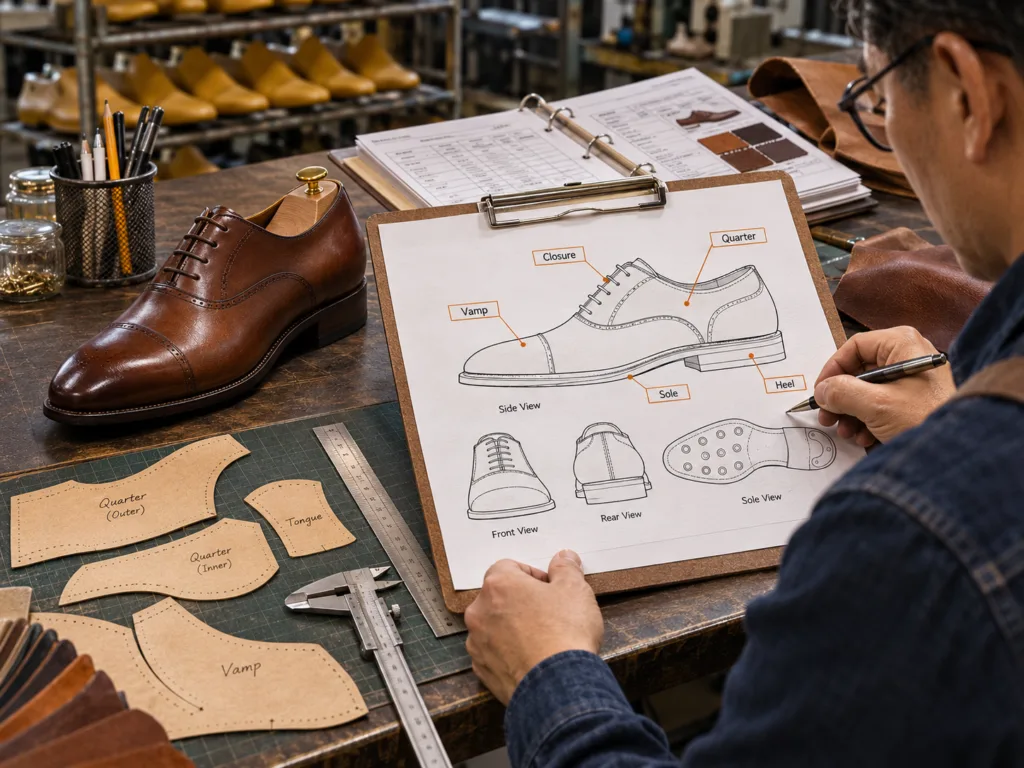
They should show enough consistent views to locate the shoe’s panels, closure, seams, ornament, heel, and visible bottom details, with callouts that lead to the corresponding part or construction record. A rendering can communicate an overall look, but a maker cannot reliably infer the rear seam, sole treatment, or hidden component from one appealing side profile.
What must front, side, rear, and sole views each locate?
The front view makes the toe shape, facing, and left-right placement legible. The side views trace the vamp-to-quarter relationship, heel profile, and sole edge. A rear view reveals backstay and heel alignment that a side profile can conceal. The sole view identifies the outline and any intended visible bottom detail. Each view should depict the same style at a consistent base reference; otherwise, the views can disagree even when every page is individually neat. Shoemakers Academy’s shoe-parts diagram identifies common parts such as the vamp, quarter, and eyestay, and its drawing guide explains the use of specification views.
For a Derby, the open-lacing area is a useful example because the facing and quarter relationship must be clear across the front and side views. A reader who needs a visual category reference can browse the site’s Derby dress shoe styles; that category page shows shoes, not the controlled drawings or dimensions for this pack. The specification still needs its own views and part references.
How do callouts link the visible shape to a cut part?
Give each relevant panel an unambiguous reference that appears on the view, the corresponding pattern record, and the BOM row. A callout for the vamp should not merely say “leather”; it should identify which cut part and material row the label means. A seam or edge callout also needs to distinguish position from making instruction. The drawing may show where a line runs, while a detail note states what joining or finishing operation it represents.
This connection prevents two opposite errors. A maker may otherwise use the right material on the wrong panel, or build the right-looking panel from the wrong material. It also gives reviewers a way to identify the affected records when one panel changes. A hidden lining cannot be verified from an external view alone; it needs its own part and material reference. Do not add a precise dimension or seam treatment just because it is plausible for a Derby; the project must specify the intended one.
Which last, pattern, and size references belong in the pack?
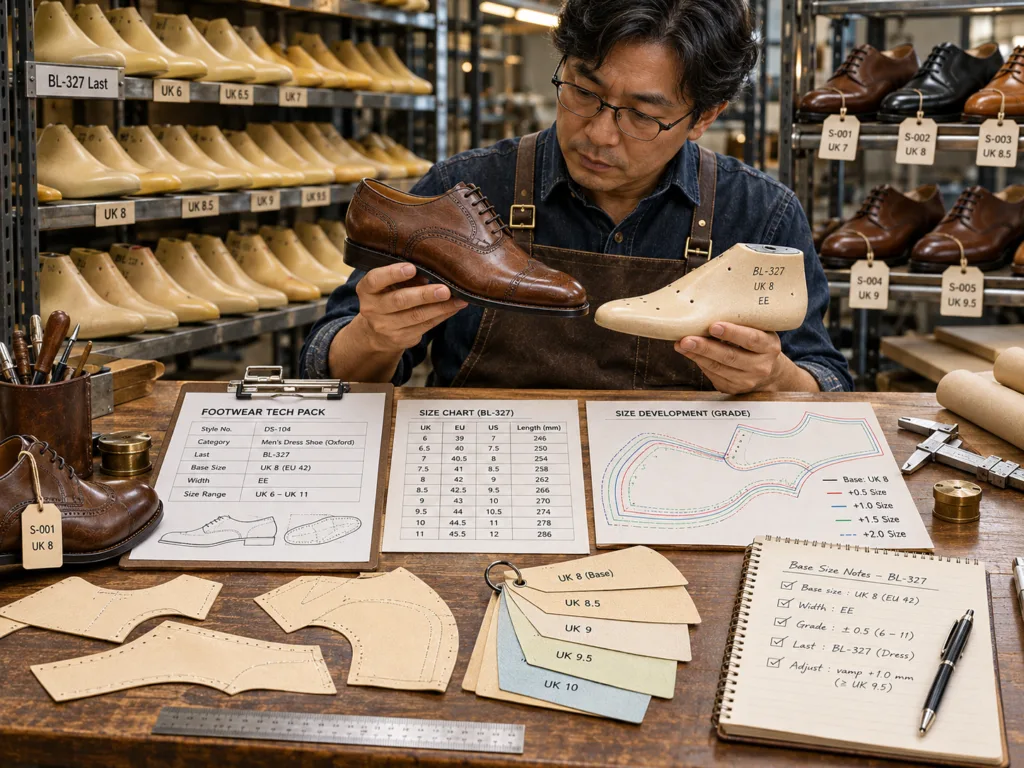
Identify the selected last, its base size and width, the pattern revision built from it, and the intended size range with its controlled size-specific references. The last is a three-dimensional shaping input, the upper pattern is cut geometry, and the finished shoe is the assembled result. A last number alone is not a measured promise that every finished size will fit a wearer.
How does the selected last connect to the base pattern?
The pack should name the actual last used for the base design and link that identity to the base upper pattern. The pattern maker needs to know which shaped form the pattern was developed around; the reviewer needs to know whether a sample was made on that same basis. If the last changes, the relationship between the foot-shaped volume, cut panels, and measurement points may change. Reusing the old pattern reference without an explicit decision could create a shoe that is visually close yet different in volume or seam position.
Measure or describe each property on the object where it belongs. A last dimension, a flat pattern dimension, and a finished-shoe measurement are not interchangeable, even if they use similar labels. State which one a target applies to and where it is taken. That allows a later sample comparison to ask the right question: did the maker use the selected last and pattern, and does the assembled pair meet the finished-shoe requirement? The tech pack records this dependency; choosing the best last for the intended market is a separate design decision. Shoemakers Academy’s last guide describes last dimensions and the pattern derived to fit the last.
What changes when the design covers more than one size?
A base-size drawing establishes the reference design; it does not supply every size’s pattern, measurement, or fit result. The pack should state the covered size range and identify how its graded patterns and size-specific measurements relate to the base. A width variant also needs an identity of its own if it changes the pattern or last. Do not assume that every length, opening, or decorative position can be obtained by uniformly enlarging the picture.
For a first sample, the team may decide to review the base size before finalizing the full range, provided the unresolved sizes are marked as such. For a repeat order, the buyer needs to know which issue of the graded patterns and measurement schedule is in force. Shoe pattern grading guidance explains that the sample-size pattern is developed before the remaining sizes and that different components may grade differently. It does not decide the commercial size distribution or substitute a wearer trial for untested sizes. The size information belongs beside, and cross-referenced to, the last and pattern references rather than buried in a marketing product description.
How should the bill of materials map to the shoe?
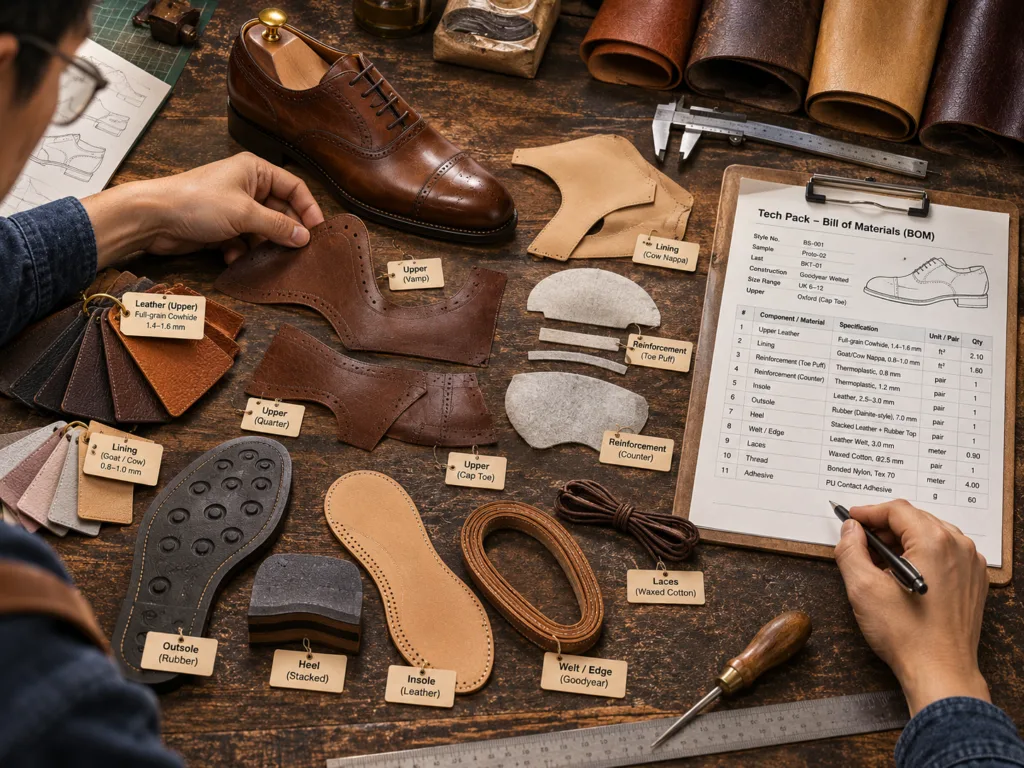
The BOM should identify each relevant physical part, its location, material, color or finish, and the attributes that affect its manufacture or acceptance. It must cover hidden layers as well as visible leather. “Black leather upper” can communicate an appearance idea, but cannot identify every panel, lining, reinforcement, bottom component, or permitted alternative.
Which visible and hidden parts need separate material identities?
Separate upper panels when they use different materials, finishes, thicknesses, or treatments. Then identify lining, reinforcement, insole, outsole, heel, and other bottom components that belong in the intended construction. Each row should lead back to a drawing or pattern callout.
A lining and an upper occupy different positions even when they appear together as one surface. Reinforcement may be invisible from outside yet affect shape and making. Leather thickness can influence pattern allowances or preparation such as skiving, so a generic material name may leave a production-relevant property undecided. SATRA’s leather discussion illustrates why leather properties cannot be reduced to appearance alone. The actual value or grade must come from the design; a BOM row does not prove performance.
How do material codes and alternatives stay traceable?
Assign the specified material to a defined part and colorway, using an identity that the maker and buyer can both recognize. If an alternative is permitted, state the part it can replace and the approval boundary. A visually similar leather may differ in thickness, finish, behavior during making, or final appearance. The pack should therefore not treat “similar” as an automatic substitution rule.
For example, imagine that the original brown upper leather is unavailable for one colorway. The buyer could approve a different material after reviewing the properties and sample affected by that choice; the revised BOM and controlled appearance reference would then identify the approved alternative. If the material identity remains unresolved, marking it as an open first-sample question is more useful than silently specifying whichever sample happens to arrive. The part-to-material map shows which specification entries must change together.
What construction and finish instructions cannot be inferred from a sketch?
Specify the joining route, seam and edge treatment, selected bottom construction, finishing target, and branding placement where they affect the intended shoe. Two pairs can share a similar outside silhouette while requiring different assembly. The pack’s job is to identify the chosen method and its interfaces; it need not teach every possible shoemaking method.
Which joins and edges need explicit instructions?
Locate important seams and joins in a detail view or callout, then state the required method or appearance where the drawing line alone is ambiguous. An upper seam line can mark the junction of panels without revealing its stitching or finishing instruction. The bottom edge can show the desired outline without revealing how the outsole attaches. The maker needs the selected construction identified in a method-specific record, with any relevant material and component references tied back to it.
A conceptual cross-section may locate upper, lining, insole, and outsole, but it should not depict a Goodyear or Blake stitch route unless that route has been specified and supported. The actual project decides those details; the general lesson is that visible shape and assembly instruction answer different questions. A clear location plus a controlled method reference lets the maker build the chosen shoe and lets the buyer know what a later sample is meant to demonstrate.
How are logo, colorway, and packaging interfaces recorded?
The artwork record should identify the logo version, its size, application method, and position for the relevant colorway. A brand mark on the insole and one on the outside upper are different placements, even if the artwork is identical. The same style and size identifiers should carry through the shoe label and any packaging field that must match the physical pair.
A shoe marked with one size and a box label carrying another is an identity conflict, not merely a packaging aesthetic issue. The tech pack can specify which identifiers must agree and where the approved artwork lives. Keeping that boundary prevents an article about a shoe’s product definition from becoming a packaging manual while still protecting a necessary product-to-pack interface.
How do acceptance criteria make the pack usable for samples and repeat orders?
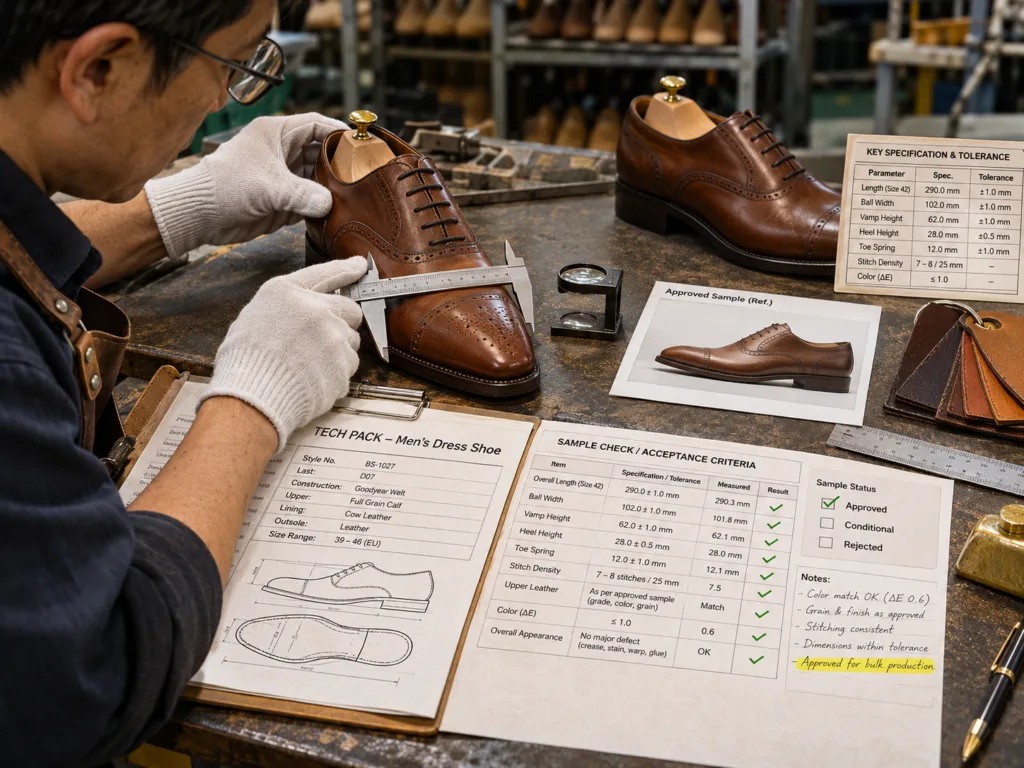
A requirement becomes checkable when it identifies the feature, the point or observation condition, the target, and the applicable tolerance or controlled reference. The criteria must belong to the same pack issue as the shoe they are used to judge. Draft criteria can guide a first sample, but an unresolved assumption should not be mistaken for an approved repeat-order standard.
What makes a measurement or visual standard checkable?
For a dimension, identify the object and exact measurement points, the method and condition, and the target. Record any tolerance alongside that value and method; one limit cannot be assumed for every part or construction. “Heel height” is incomplete if one person measures at the rear edge and another at a different point. For a visual attribute such as a finish or color, a controlled physical sample or swatch and suitable observation condition may convey the target better than an unsupported adjective.
Some attributes need both kinds of evidence. A shoe may look correct in a photograph while a component identity or hidden performance remains unproven. A reference swatch can guide appearance, but it cannot alone establish leather strength or a bottom bond. The acceptance record should therefore make clear what observation establishes and what requires another method. This is how the tech pack supports a later sample decision without pretending that writing a criterion means the pair has met it.
What differs between a first-sample issue and a repeat-order issue?
A first-sample pack may contain explicit open questions: for example, a finish choice awaiting a sample comparison. The document should mark that point as unresolved while keeping the other defined attributes stable. A repeat-order issue should instead identify the approved product definition, its controlled reference sample, and the permitted variation or substitution limits. If a material changes after approval, the affected drawing, BOM, acceptance reference, and sample record need a deliberate relationship to the new issue.
The pack states what the buyer intends to have made; approving a representative pair requires comparing what was actually made with that definition and deciding how deviations are handled.