Haz clic para desplegar el índice
Índice
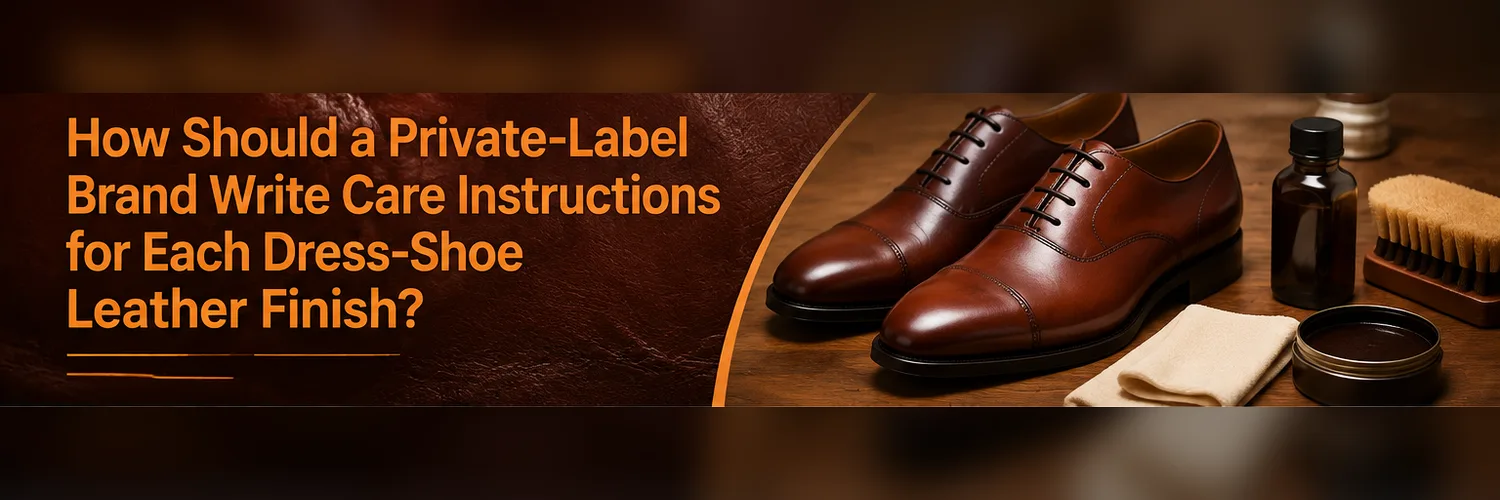
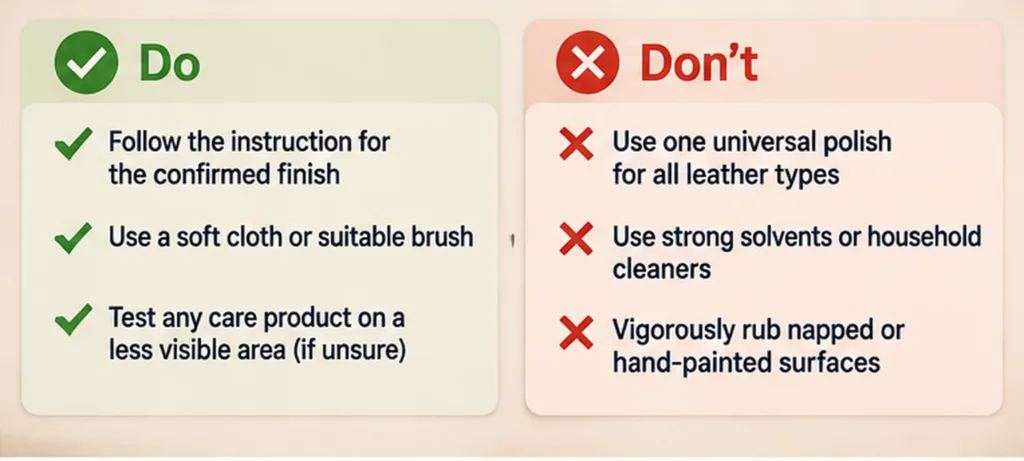
Write the instruction for the confirmed finish on the actual shoe, then tell the wearer what to do for routine dust, what changes after water or a stain, which action to avoid, and what visible result means they should stop. “Clean, condition and polish” is not a safe universal sequence: a coated smooth upper, aniline leather, a napped surface and a hand-painted finish present different surfaces to a brush, cloth, liquid or care product. The brand’s task is to convert that difference into short, usable customer wording. It need not promise a named cleaner, a drying time or a recovery result that the particular shoe has never demonstrated. A helpful instruction tells the wearer which branch applies and what action to take next.
Why does the actual surface finish change the care instruction?
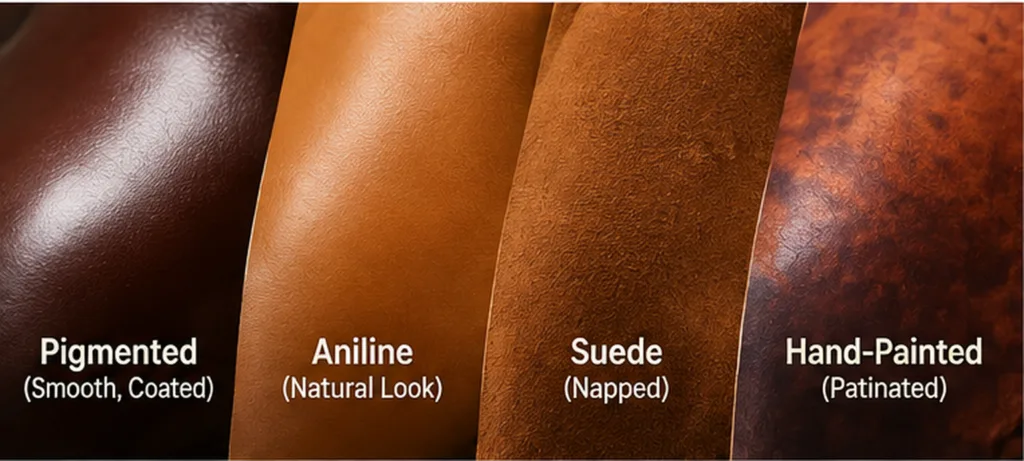
The finish controls what a cloth, brush, liquid or care product meets first. A pigmented layer presents a different contact surface from a more open aniline surface; suede or nubuck presents a nap that can change direction when brushed. Consequently, the same wiping or polishing motion can produce different appearance changes. Leather Naturally’s care guide distinguishes care by leather type and finish rather than giving one treatment for all leather.
Upper identity matters more than silhouette. Two Oxford shoes can need different routines if their finishes differ; a Derby and Oxford with the same confirmed finish may share a surface-care principle. Write for the material on the released shoe, then adapt to its details.
What can a brand infer from a smooth, coated-looking upper?
A smooth, even-looking upper may suggest a pigmented finish, but appearance cannot identify the coating or prove that a particular cleaner is compatible. The care line should name the confirmed surface type. Aniline leather can look smooth too while allowing liquid and staining to affect its appearance differently from a more protected surface. The Leather Naturally guide describes distinct approaches for these surfaces, which is why a brand cannot classify the customer’s shoe solely by a catalog photograph.
The instruction can still be plain language. “For the smooth, pigmented leather upper” is more useful than an unexplained processing term if that is the actual finish. Then the action can be limited to gentle dust removal and to a care product the brand has identified as compatible with the specific finish. If that compatibility is not established, omit the product recommendation rather than replacing it with an untested universal polish. This is not a demand that a wearer investigate leather chemistry. It is a responsibility of the brand preparing the leaflet: the wearer should be able to recognize which instruction belongs to the shoe they bought.
How do nap and hand-painted surfaces change that starting point?
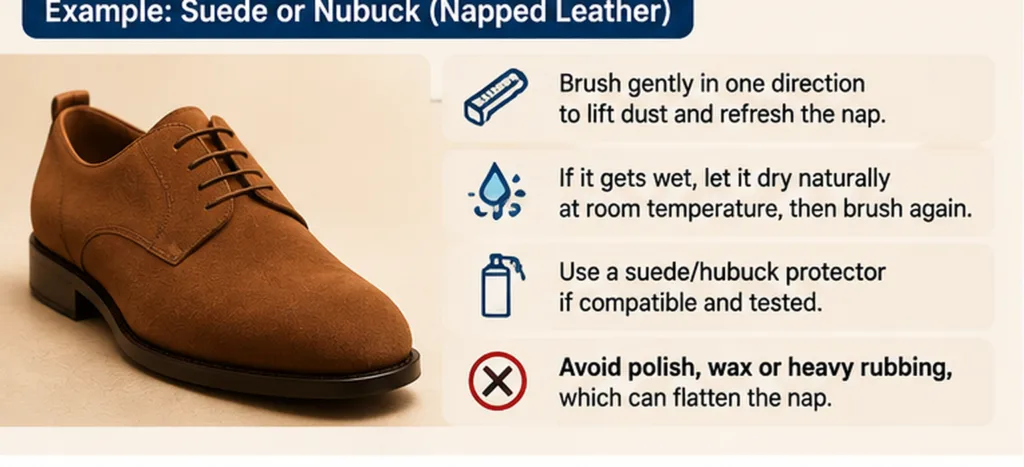
A napped suede or nubuck upper calls for a method that works with its texture, such as gentle brushing, not the polish-and-buff routine used for some smooth leathers. The direction of the nap can affect apparent shade, so a strong rubbing action can change the look even without removing color. Leather Naturally’s guide treats these surfaces separately from smooth leather. A brand should therefore name the napped finish and show the wearer the gentle routine, not merely say “care for leather.”
Hand-painted leather raises a different issue: a surface color effect can be disturbed by an incompatible product. Loake’s hand-painted shoe care advice warns against transferring ordinary product assumptions to that finish. That advice is useful as a mechanism and caution, not proof that a Loake product is suitable for another maker’s article. For a private-label shoe, the instruction must reflect its own finishing system. If that system has no confirmed cleaner, a safe instruction can still cover dry dusting, avoidance of solvent-rich products and a stop point for color lifting. It should not pretend to offer a complete restoration recipe.
What routine can the instruction give for each confirmed finish?
Give one low-impact action for normal dust, followed by the condition that changes the action. The surface identity determines whether the instruction starts with a soft cloth, a nap brush or an even more restricted method. A small-area trial helps prevent spreading an unexpected appearance change, but it is not a substitute for a verified finish-specific product recommendation. The table below is a compact wording guide for a brand editor; it assumes the row’s surface has been confirmed on the released shoe. The distinct care paths are supported by Leather Naturally’s guide and the hand-painted exception by Loake.
| Confirmed upper surface | Routine line for the wearer | Event condition or action to avoid | Stop and aftercare trigger |
|---|---|---|---|
| Pigmented smooth leather | Gently remove dry dust with a soft cloth | Use only a compatible cleaner after a discreet trial; do not scrub | Stop if the finish visibly changes or lifts |
| Aniline leather | Remove loose dust gently and dry | Try any damp action first in a hidden area | Stop if the trial darkens or spreads a mark |
| Suede or nubuck | Gently brush the nap with a suitable brush | After wetting, allow ambient drying away from heat; do not polish | Stop before forcing a persistent stain |
| Hand-painted leather | Remove loose dust gently | Avoid solvent-rich products; follow care guidance for this shoe’s actual finish | Stop if color begins to lift or smear |
What can be said for a pigmented smooth upper?
Tell the wearer to remove loose dust gently before considering any cleaner, and restrict a cleaner to one compatible with the confirmed finish. A pigmented surface can offer a layer between immediate contact and the underlying leather, but that does not make vigorous scrubbing harmless or every cream suitable. Leather Naturally’s finish-specific care guidance supports a restrained, surface-aware action rather than a blanket treatment for all uppers.
The wording should specify the motion in familiar terms: use a soft cloth without rubbing hard enough to alter the sheen. If a cleaner has been approved for that shoe, name the compatible product or product type and instruct a small trial in a less visible area before broad application. If no product has been established, do not insert a generic “leather cleaner” to fill the line. The useful customer answer is that ordinary dust can be removed safely with a low-impact method and that an unfamiliar substance calls for a trial or aftercare advice. A leaflet that merely says “clean as needed” leaves the wearer to guess at the action most likely to change the finish.
How should the aniline instruction handle moisture and trial use?
Start with dry, gentle dust removal, and make any damp cleaning conditional on a hidden trial that does not visibly darken or mark the surface. Aniline leather displays more of the material’s natural character and may show liquid contact more readily, so the wearer needs an observable condition rather than a promise that a damp cloth is harmless. Leather Naturally’s care guide links care choices to the leather’s finish and the effect of moisture.
Tell the wearer what to watch for. Try the proposed method in a tiny, hidden area and compare it after it settles. Darkening, a spreading edge or changed sheen means stop before treating the visible vamp. The trial sets a boundary for this action; it does not certify every future stain.
What should a suede or nubuck instruction replace polishing with?
Replace smooth-leather polishing with gentle nap brushing for ordinary dry dust. The brush works with the raised surface instead of applying a cream that may flatten or mark it. For a wet shoe, the first instruction is to let it dry naturally away from direct heat before brushing or attempting further treatment. Leather Naturally’s care guide differentiates napped leather care and cautions against inappropriate heat or treatment.
The sequence matters: brushing wet material can move dirt into the nap, while ambient drying reveals what remains. Trial any further compatible treatment discreetly because moving or wetting the fibers can alter their appearance. Do not urge brushing until a persistent stain disappears; stop before abrading the surface.
What may be said about hand-painted or patent finishes?
For a hand-painted finish, give only a gentle routine supported by the actual care system and warn against solvent-rich products that could disturb surface color. Loake’s guidance for its hand-painted leather illustrates the risk, but its named products or methods cannot be transferred automatically to an unrelated private-label shoe. The brand needs a finish-specific direction for its own article before recommending a cleaner.
For patent leather, a smooth-leather or hand-painted routine should not simply be copied across. The brand should give a separate instruction matched to the actual coated surface and its approved care products. Until that route is specified for the shoe, the customer-facing line can explain how to remove loose dust gently and when to stop, without naming an untested cleaner or polishing treatment.
What should the instruction say after wetting or staining?
Separate an event from the normal dust routine. Water and stains can change how a finish looks, so the wearer should avoid increasing contact or force while the condition is still developing. Natural drying is the first response to a wet shoe; a persistent stain calls for a finish-compatible trial or aftercare route rather than stronger rubbing. The Leather Naturally guide supports treating moisture and surface type as material conditions, not as a reason to apply the same polish to every upper.
How does a wet shoe change the next step?
Blot excess surface moisture gently, then let the shoe dry at ambient temperature away from direct heat before judging the remaining mark. The instruction should not promise that drying will reverse staining, color change or finish damage. A wearer needs to know both the immediate action and why to wait: while the surface is wet, further rubbing or product application can spread an uneven appearance. Once dry, the remaining condition is easier to see and can be handled according to the actual finish.
Avoid an arbitrary drying-time promise: upper construction and environment change the time needed. Tell the wearer to wait until the upper is dry to the touch, then assess it before brushing or using an approved treatment. Keep it away from radiators and hair dryers. For suede and nubuck, drying before restoring the nap is especially important. The Leather Naturally care guide supports natural drying without proving a restoration outcome for this shoe.
When does a stain call for a trial rather than more force?
When a mark persists after the low-impact routine, try only a finish-compatible action on a discreet area and stop if the test darkens, spreads, abrades or lifts the surface. More pressure is not a reliable escalation. It may enlarge the affected area or turn a removable surface deposit into a changed finish. The instruction should name the observable trigger and the next step: do not continue across the visible upper; contact the brand’s aftercare route for that shoe.
The trial belongs to the actual finish: a cleaner used on coated black leather cannot automatically be applied to aniline or hand-painted leather. The wearer needs a visible stop trigger, not a laboratory term; if the hidden test changes colour, stop before treating the exposed upper.
How should the brand turn these branches into customer-facing wording?
Put the confirmed finish name, a routine action, an event condition, an action to avoid and a visible stop trigger into one coherent instruction. The leaflet must tell the wearer what to do without making them infer the finish from appearance. Use the shortest sequence that still changes behavior. The brand may hold more detailed material and care information internally, but the released wording should be understandable next to the shoe.
One way to test the copy is to imagine a customer finding dust on Monday and a water mark on Friday. They should find a routine line for the first event and a separate response for the second. If both routes point to the same unspecific “use leather care products,” the wording has not captured the material difference. If the copy lists many warnings but no first action, it also fails. The goal is an executable branch, with a clear stopping point when the expected result does not occur.
What information belongs in the routine line and what belongs in a condition?
The routine line should cover ordinary dust on the confirmed surface; the conditional line should say how the action changes after moisture, staining or an uncertain product response. For example, a hypothetical instruction for a confirmed pigmented smooth upper could read: “Remove dry dust with a soft cloth. For a mark, use only the compatible cleaner specified for this shoe and try it first in a hidden area. Stop if the finish changes visibly.” This example is a writing model, not a statement that Hengxin has approved a particular cleaner or that every pigmented shoe will recover from a mark.
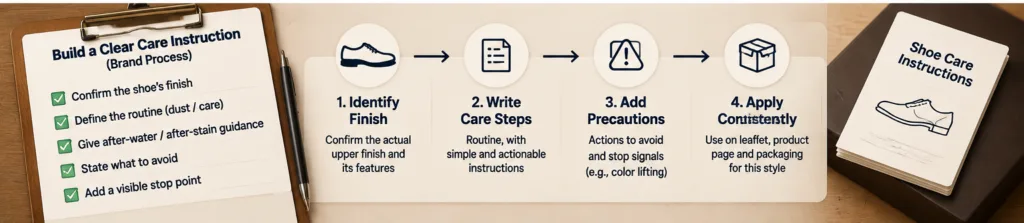
The phrase “for this shoe” is important. A private-label brand may use multiple upper materials across similar-looking styles. A care line copied from another SKU could tell the wearer to polish a nap surface or apply a solvent-containing product to a hand-painted finish. To avoid that, the released instruction needs to be tied to the actual material assignment for the shoe. It does not need a long material science lesson; the customer needs the correct route and a reason to stop when the material behaves differently from the expected route. Distinguishing routine from event response also keeps the instruction short enough to be used.
How should the instruction state a stop point without becoming a disclaimer?
Name a change the wearer can see and a next action they can take. “Stop if the hidden trial darkens the leather, moves the color or lifts the finish; ask the brand for care advice for this shoe” is an instruction. “Results may vary; consult someone if uncertain” is too vague to guide action. The trigger must correspond to the surface and proposed treatment: a napped shoe may show flattening or an altered patch, while a smooth coated upper may show a changed sheen or lifted layer.
This stop line protects the intended appearance without claiming that every problem can be repaired. It also helps customer service respond to a specific observation rather than a generic complaint that the shoe “looks different.” The brand can ask which finish and action were involved, then advise from the shoe’s actual care system. The customer should not be asked to diagnose a finish they were never told about. Clear wording turns the finish-specific knowledge held by the brand into a practical decision for the person wearing the shoe.
For a private-label program, the useful next step is to pair each released upper finish with a short care line and review it against the sample shoe before including it with the product. Hengxin can discuss the intended upper and proposed customer wording during development; the instruction should describe only the care actions supported for that actual shoe.