Haz clic para desplegar el índice
Índice
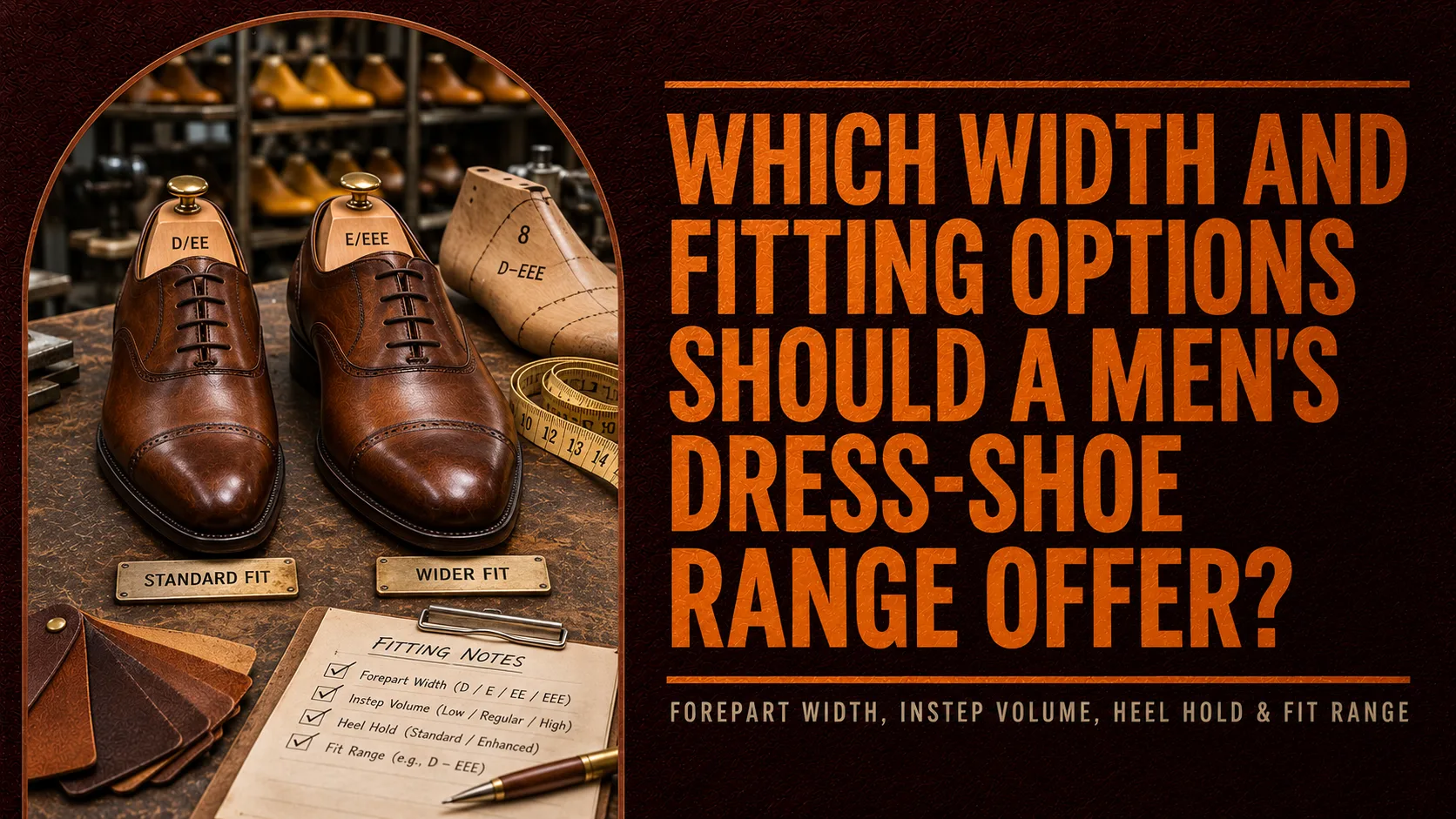
A men’s dress-shoe range should offer an additional width or fitting only when a repeatable group of intended wearers has a local fit problem at an otherwise suitable length and a distinct shoe option solves it without creating another problem. Length, forepart girth, instep volume and heel hold are different dimensions. A wide label is useful when it corresponds to a defined fit choice; it is not a substitute for measuring the foot or testing the actual shoe.
For a B2B brand or wholesale buyer, the decision is an architecture for the offer: which people can use the base fit, which need another fit, how each option will be specified, and whether the added choice is worth its development and assortment complexity. The range of length labels is a related but separate decision. This article assumes that a proposed length run already exists and asks what, if anything, should vary within it.
Why can shoes of the same length need different fittings?
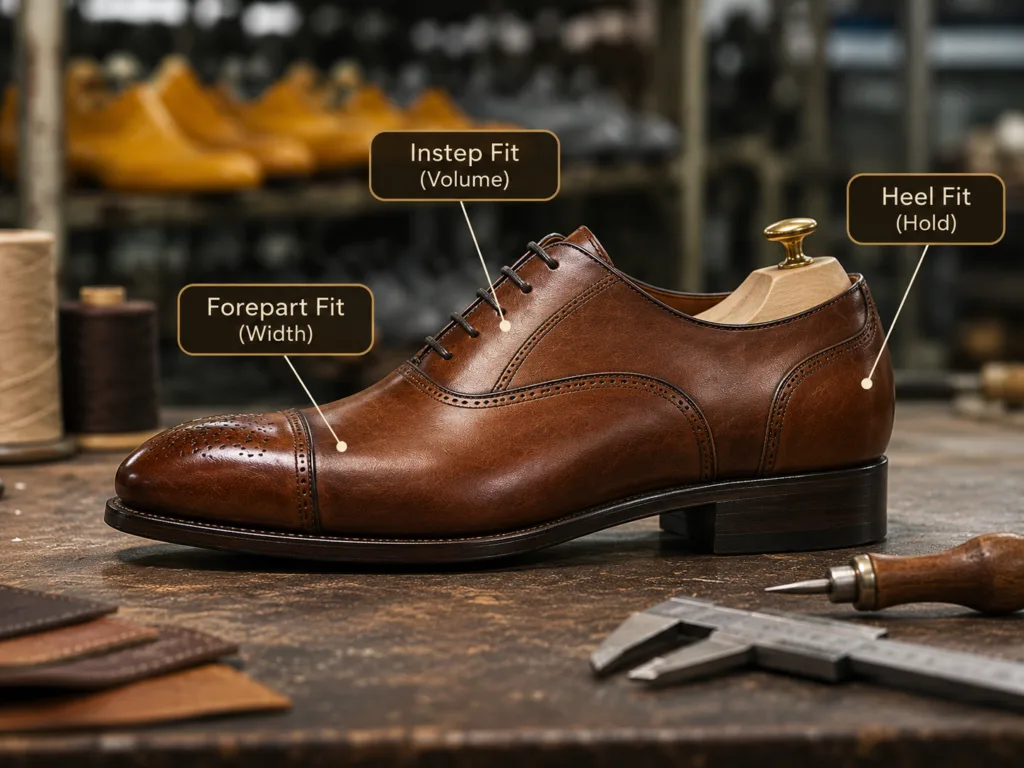
Two feet with similar heel-to-toe length can require different local spaces. Forepart girth describes the region around the ball of the foot, instep volume affects how the upper closes across the top, and the heel needs enough hold to limit unwanted movement. A length marking cannot encode all those relationships. SATRA’s account of measuring feet, lasts and footwear distinguishes the dimensions of the foot and last from the finished shoe’s fit.
This matters because increasing length is a tempting but crude response to pressure. Moving to a longer shoe may provide more overall space while moving the flex region and reducing heel retention. Conversely, a wider forepart option can relieve joint pressure while leaving length approximately as intended. Neither change is automatically right; the location and repeatability of the mismatch determine which hypothesis deserves a trial. A fitting range is therefore a set of distinct spatial options, not just extra letters next to a size number.
What does a wider forepart change, and what does it leave unchanged?
A wider forepart option changes the space available around the front of the foot. It is a credible response when otherwise appropriate-length shoes repeatedly compress the joints or toes from the sides. It does not inherently correct heel slip, an instep that cannot sit beneath the upper, or a flex point that falls in the wrong place. Each of those observations points to a different relation between foot and shoe.
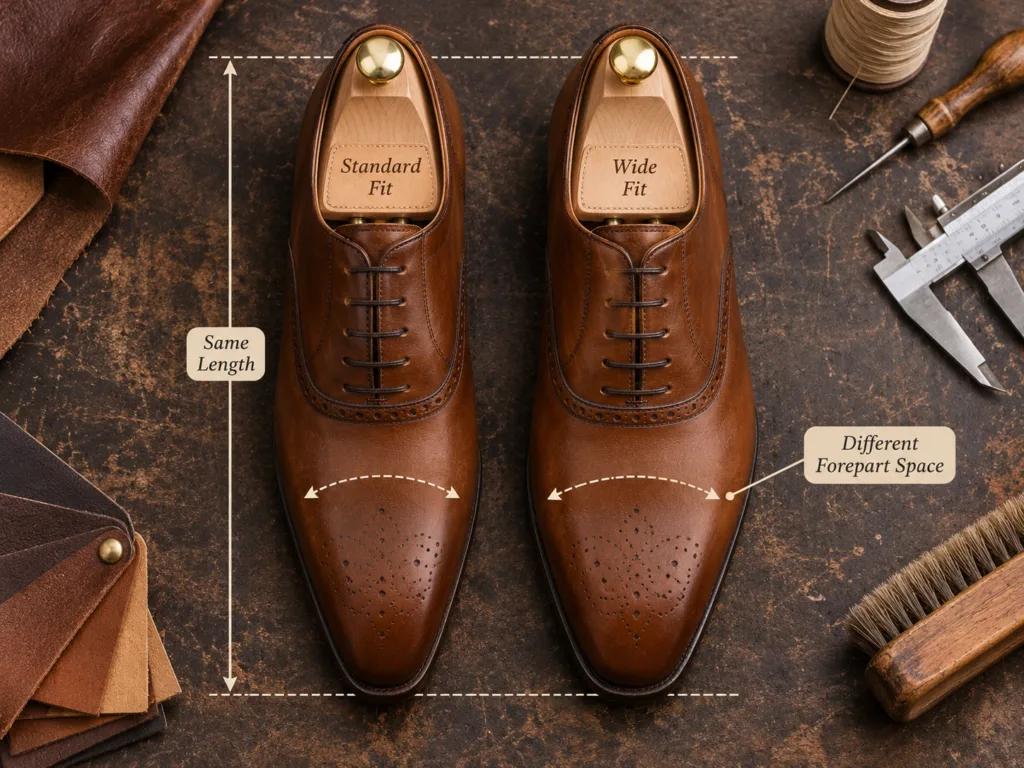
Imagine two hypothetical wearers with comparable measured length but different forepart girths. The base sample may accommodate one without pressure while the other feels compression across the ball. A second forepart shape could serve the latter group without changing the length mark. That is a reason to compare the actual circumferences and sample shoes. It is not evidence that every wearer called “wide” needs one universal extra increment, nor that a printed width letter has the same dimensions across brands.
Shape matters alongside maximum width: pressure may occur at one joint even when a width reading looks plausible. If it appears in only one style, adjust that style before proposing a range-wide fitting.
How do instep and closure change the same marked width?
Instep height and the way the shoe fastens can change usable space even when the forepart width label is unchanged. A lace-up shoe permits some adjustment at the opening, but its upper and last still limit the range of accommodation. An elastic or less adjustable opening behaves differently. A person can therefore report pressure over the top while the forepart itself is comfortable, or have adequate forepart space yet struggle to secure the heel.
Assess the intended construction rather than treating a width marking as a property of the foot alone. ISO 19409:2022’s public description concerns measurable dimensions of a footwear last; a last dimension is not identical to the anatomical dimension of the foot wearing the finished shoe. The upper, lining, closure and production choices mediate the space. This does not require the buyer to become a last designer. It requires specifying the region the alternative fit must change and checking that the sample does so.
Which recurring fit patterns warrant another option?
An added fitting is warranted when a meaningful subgroup of intended customers repeatedly shows the same local mismatch at a sound length choice, and trials show a distinct option improves that mismatch without a new one. A single complaint identifies a possible test, not a new range. Fit observations and foot measurements must be read together so that a wider forepart is not offered to solve a heel or instep problem.
| Repeated observation at suitable length | Local space to compare | Candidate action | Trial signal supporting or rejecting it |
|---|---|---|---|
| Forepart compression across several wearers | Joint girth and front-of-shoe shape | Trial a distinct forepart-volume sample | Side pressure eases without new heel movement |
| Pressure over the instep with acceptable forepart | Instep space, opening and closure | Trial a relevant volume or opening change | Top pressure eases and closure remains secure |
| Heel slip without front pressure | Heel hold, length and fastening | Do not default to a wider forepart | Heel retention improves without front looseness |
| One inconsistent report | Repeat conditions and local observation | Keep the proposed offer provisional | A repeatable group pattern emerges or does not |
SATRA’s fitting assessment description supports comparing measurements with wearer trials. The decision to add a range option comes from the observed subgroup benefit, not a universal numerical threshold.
When is a wide forepart option the right hypothesis?
It is the right hypothesis when wearers with comparable suitable length repeatedly report side pressure in the forepart, their measured girths or shapes differ from those served by the base shoe, and a wider front sample can be compared under similar conditions. The measurement helps explain the pattern; the trial tests whether the proposed shoe actually relieves it.
Check that the base size is not simply too short before attributing all front pressure to girth. A cramped toe end and a tight joint region may coexist, but they call for different alterations. Keep the intended length label fixed for the comparison where possible. If both length and width change at once, a more comfortable trial will not tell the buyer which choice caused the improvement. Also watch the heel and instep: a front volume gain that creates instability elsewhere is not an unqualified success.
The word “wide” should follow this design decision, not lead it. Some customers may benefit from a changed shape rather than uniformly increased width. A fit option can be described by the spatial problem it solves, then given a customer-facing name that the brand can use consistently. Avoid assuming the same option works equally across Oxford, Derby and other constructions merely because their labels match.
Which complaints should not trigger a wider last?
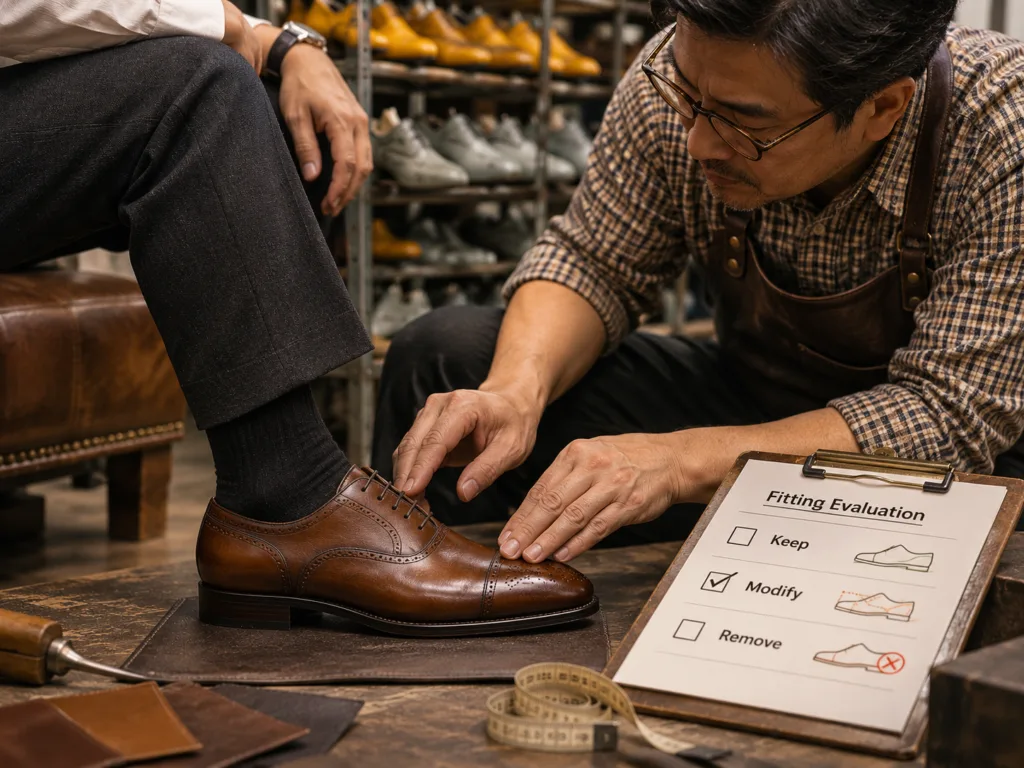
Heel slip alone should first prompt a check of length, heel shape and fastening. Increasing forepart space does not inherently grip the heel; it may leave the front loose while the heel still moves. Likewise, pressure over the instep can call for a different volume or opening relation rather than a broader toe region. The visible site of discomfort is a clue, but the entire foot-shoe interaction determines the remedy.
If a wearer loosens laces substantially to relieve instep pressure and then reports heel movement, the two observations may be linked through closure rather than through forepart girth. A trial should compare the shoe properly fastened under a repeatable method before adding a wide version. This is a practical interpretation, not a diagnosis of any individual’s foot. In a range decision, the point is to avoid turning every form of discomfort into the same extra SKU.
What counts as evidence of a real customer subgroup?
Look for the same pattern across representative intended users, with the same shoe, relevant length sizes and comparable try-on conditions. Record where pressure or movement occurs and which measurements distinguish the people affected. The group need not have an invented percentage threshold; it does need to be more than one inconsistent observation.
Who the intended users are matters. A brand selling to a defined account may reasonably design for that account’s repeated fit pattern. A range meant for a wider market should avoid treating one local store’s comments as a complete population. Where observations are sparse, retain the alternative as a test hypothesis and decide what additional trial would resolve it. This is different from indiscriminately offering every conventional width label in the hope that one will fit.
How should the options be specified and named?
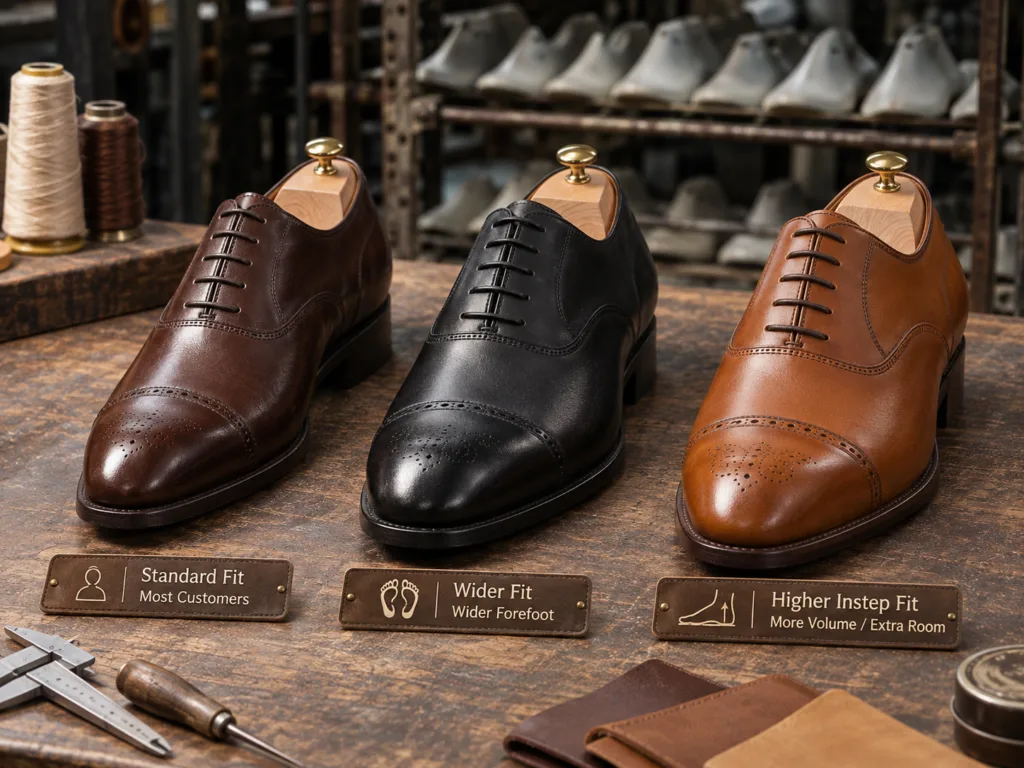
Specify each option by its last and sample reference, the local fit difference it is designed to provide, and the wearer group it has helped in trials. Then choose customer-facing names that remain consistent within the collection. A letter such as D or E, or a word such as regular or wide, should identify the brand’s actual option rather than imply universal cross-brand dimensions.
This turns a promising trial into a repeatable wholesale specification. A buyer should be able to distinguish the base and alternative fits in a size list, sample set and order form, while understanding what changed physically. If an option is only a different upper style on the same last, it should not be presented as a measured width variant without evidence. If two options use distinct lasts, the relationship should be recorded even if marketing uses simpler labels.
Why are width letters insufficient across brands?
Width letters are labels applied within a sizing and fitting system, not portable dimensions. Brannock’s fitting instructions determine a width reading in relation to the measured shoe length and caution that manufacturer width descriptions vary. A customer who wore one brand’s “wide” shoe cannot infer that another brand’s same label has an identical forepart, instep or heel.
The buyer can still use familiar language for navigation. The important step is to define what the label corresponds to in this collection: which last or fit reference, which sizes carry it, and what the sample trials demonstrated. State any relationship to a measurement method accurately rather than suggesting that an equipment reading directly certifies the finished shoe. A concise fit description may say that one option provides more forepart room at the same nominal length, if samples support that distinction. It should not claim that every customer with a particular letter reading will fit it.
State which lengths and constructions offer the alternative fit so buyers do not assume an unavailable length-and-width grid.
What else changes when a second fit is offered?
A distinct fit can require a separate last progression, samples, production references and assortment positions. The precise costs and minimums depend on the real programme; no universal figure follows from adding a label. Hengxin’s existing collection-planning discussion describes the broader tension among assortment breadth, size depth and replenishment. Applied here, every additional fit should provide a distinct wearer benefit that justifies the extra complexity.
The complexity is not merely administrative. A buyer may need to keep base and alternative samples identifiable during approvals, ensure an order form distinguishes them, and explain their use to wholesale accounts. If two nominal variants feel indistinguishable in the intended shoe, carrying both can confuse choice without improving coverage. If a second option demonstrably solves a repeated mismatch, the effort may be justified even if it serves a narrower group. That trade-off should be evaluated against the target customer and collection role, not an assumed rule that more choices are always better.
How can the range confirm that each fitting earns its place?
Trial the base and proposed alternative in the intended shoe on people representing the relevant length and local fit patterns. Hold try-on conditions as constant as practicable, compare pressure, closure and heel hold, and keep only an option that provides a distinct, repeatable improvement for its intended group. A label is approved after the shoe demonstrates its purpose, not before.
The trial should answer a specific hypothesis: for example, “Does an alternative forepart shape relieve repeated joint pressure at this otherwise appropriate length without creating heel slip?” That question is more informative than asking whether the wide shoe feels generally nicer. Capture observations at more than one relevant length if the option is intended across a range; a successful centre sample does not prove that its edges behave the same way. The design and trial references need to travel with the final option description.
What should be held constant in the try-on?
Keep the intended style and construction, length basis, socks, fastening and trial activity consistent enough to isolate the fitting difference. If the base shoe is an Oxford and the alternative is a different Derby with a different upper and heel, a comfort difference cannot be attributed solely to width. The samples need not be laboratory-identical, but every material difference should be understood when the result is interpreted.
Measure or record the wearers’ length and relevant girth or instep characteristics under the same method. Have each person try both feet, fasten the shoe as it will be worn, stand and walk for a comparable period. Record the location of pressure or movement, not only a single score. Different people may prefer different levels of closeness; the programme question is whether a defined group repeatedly benefits from a distinct option.
If the second fitting is available in only a subset of lengths, trial within that subset and do not generalise the result to unmade sizes. If the target shoe changes materially after approval, retest the affected fit relationship. This prevents the range from preserving a name while losing the physical option that gave the name meaning.
What result supports adding, changing or declining an option?
Add the option when the target subgroup repeatedly gains relief at the identified region and does not acquire a new, material problem in heel hold, instep or overall movement. Revise the option when the trial improves one region but fails another. Decline or postpone it when the pattern is not repeatable, the proposed sample does not produce a distinct benefit, or the original complaint is better explained by length or closure. These outcomes are more useful than an unqualified vote for “wide.”
Consider a hypothetical trial in which several otherwise suitable-length wearers feel forepart compression in the base shoe. If an alternative front shape relieves that pressure and preserves heel hold in repeated comparisons, the buyer has a reason to offer it. If the same alternative removes pressure but makes the heel unstable, the trial supports redesign or a more targeted shape, not automatic approval. No particular brand result is implied by that example.
The approved output should identify each offered length-and-fit combination, its last and shoe reference, its intended local benefit, and the trial observation supporting it. It should also state where the option was not tested or not offered, without padding the customer-facing description with internal review details. A B2B buyer can then discuss sample feasibility and a possible range with Hengxin using the proposed wearer group and fit difference, rather than requesting a generic catalogue of width letters. The core decision remains with the evidence from the intended shoe and users.