Haz clic para desplegar el índice
Índice
What does choosing a dress shoe last actually decide?
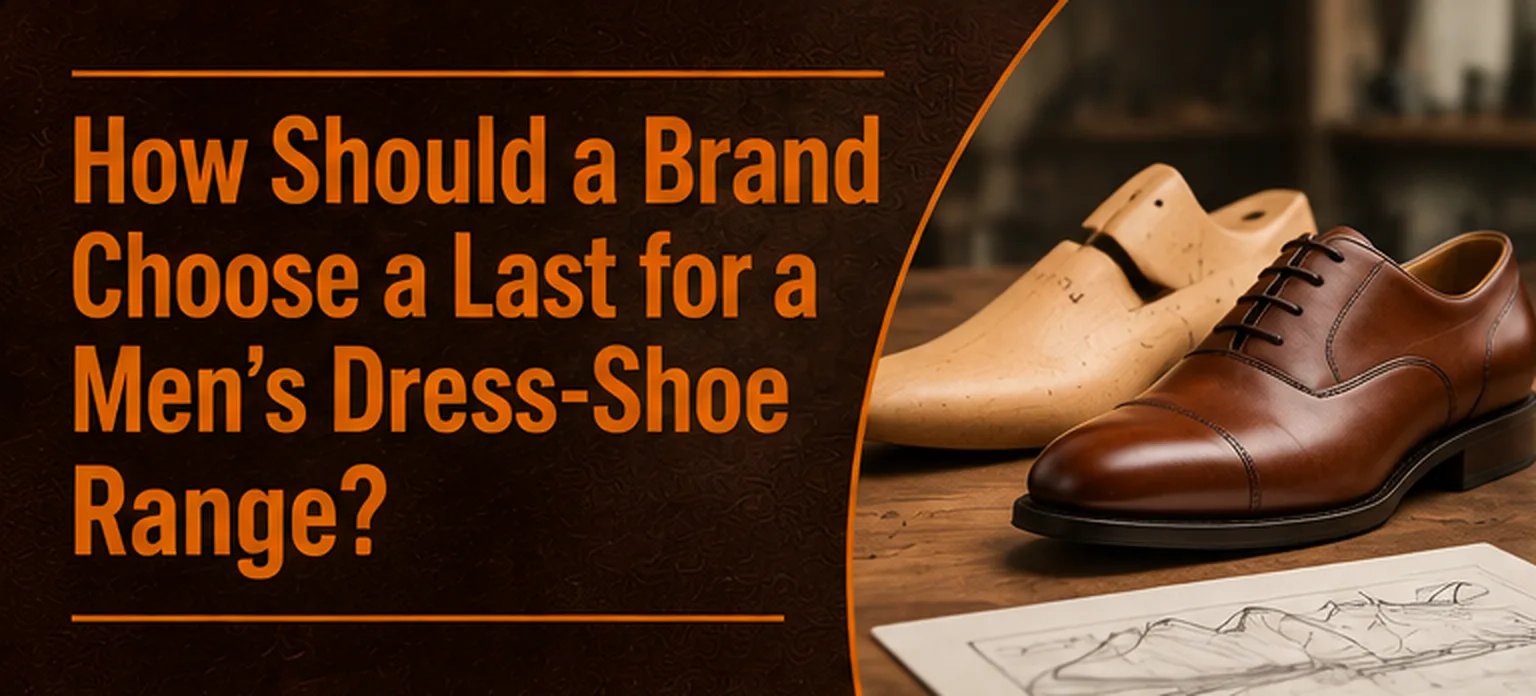
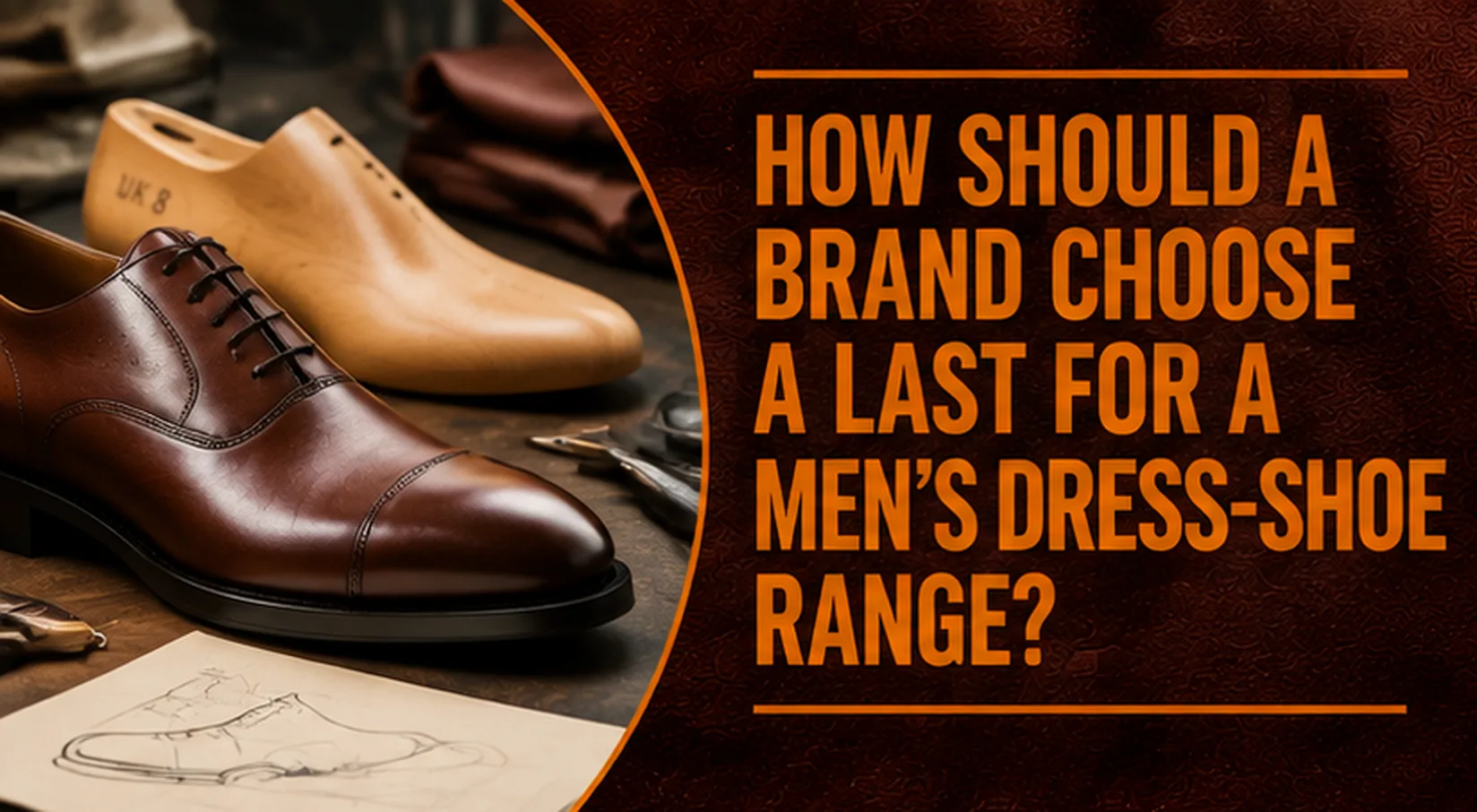
A last is the form around which a shoe is developed. Its forepart, ball region, instep, waist, heel seat, bottom and toe spring establish interacting parts of the shoe’s geometry. The Shoemakers Academy explanation of shoe lasts identifies these regions and the measurements used to describe them. Choosing a last is therefore a decision about the potential shape and space of a finished shoe, not simply about whether its pointed or rounded toe looks attractive on a drawing.
The last is not a copy of a foot. It must accommodate a foot in a shoe that has its own upper, lining, sole and construction. SATRA’s discussion of measuring feet, lasts and footwear distinguishes those three measurement layers and notes that materials and making processes affect the finished result. A last that appears suitable in isolation may produce a shoe with different contact or hold after the upper and bottom are made. The buyer’s selection must therefore connect target-foot landmarks, last geometry and the intended finished style.
Which geometry points must be compared together?
Compare ball position and forepart girth alongside instep volume, waist, heel seat and bottom shape. A change to one region may affect another feature of the shoe. For example, changing the forepart may alter an upper pattern’s contact around the ball; altering heel or bottom geometry can affect how upper and sole components meet. SATRA’s account of modern last design describes adjustments to toe, forepart, rear, heel height, bottom and toe spring and their relationship to later components. The point is not that every adjustment causes a known amount of change; it is that a single dimension cannot be judged apart from the rest of the intended shoe. A buyer should identify which relationship a proposed last solves and which adjacent relationship a modification might disturb.
How should target feet shape the last requirements?
Start with the people the shoe is intended to serve, measured in a consistent, weight-bearing condition. Heel-to-toe length establishes one dimension, while heel-to-ball length locates the forefoot’s working region; width and relevant girths describe how much lateral and vertical space the shoe may need. The Brannock instructions treat heel-to-toe, heel-to-ball and width as distinct observations. They do not prescribe a last for a brand, but they explain why a single average length is an incomplete foundation for selecting one. A buyer should know whether the target group shares the critical landmarks of the candidate last, rather than accepting a general “standard foot” description.
Mapping foot to last means comparing corresponding regions, not drawing one outline on top of the other and expecting exact coincidence. Locate the heel, ball and forepart of the intended foot, then assess how the last positions and contains them. A dress shoe’s external toe can extend beyond the functional toe region for appearance, while the usable forepart must still accommodate the foot. If the ball of the last is positioned poorly relative to the target foot, a visually generous toe may not solve the bending and forepart problem. This is a geometric judgment to test in a finished shoe, not a promise that a paper measurement alone guarantees comfort.
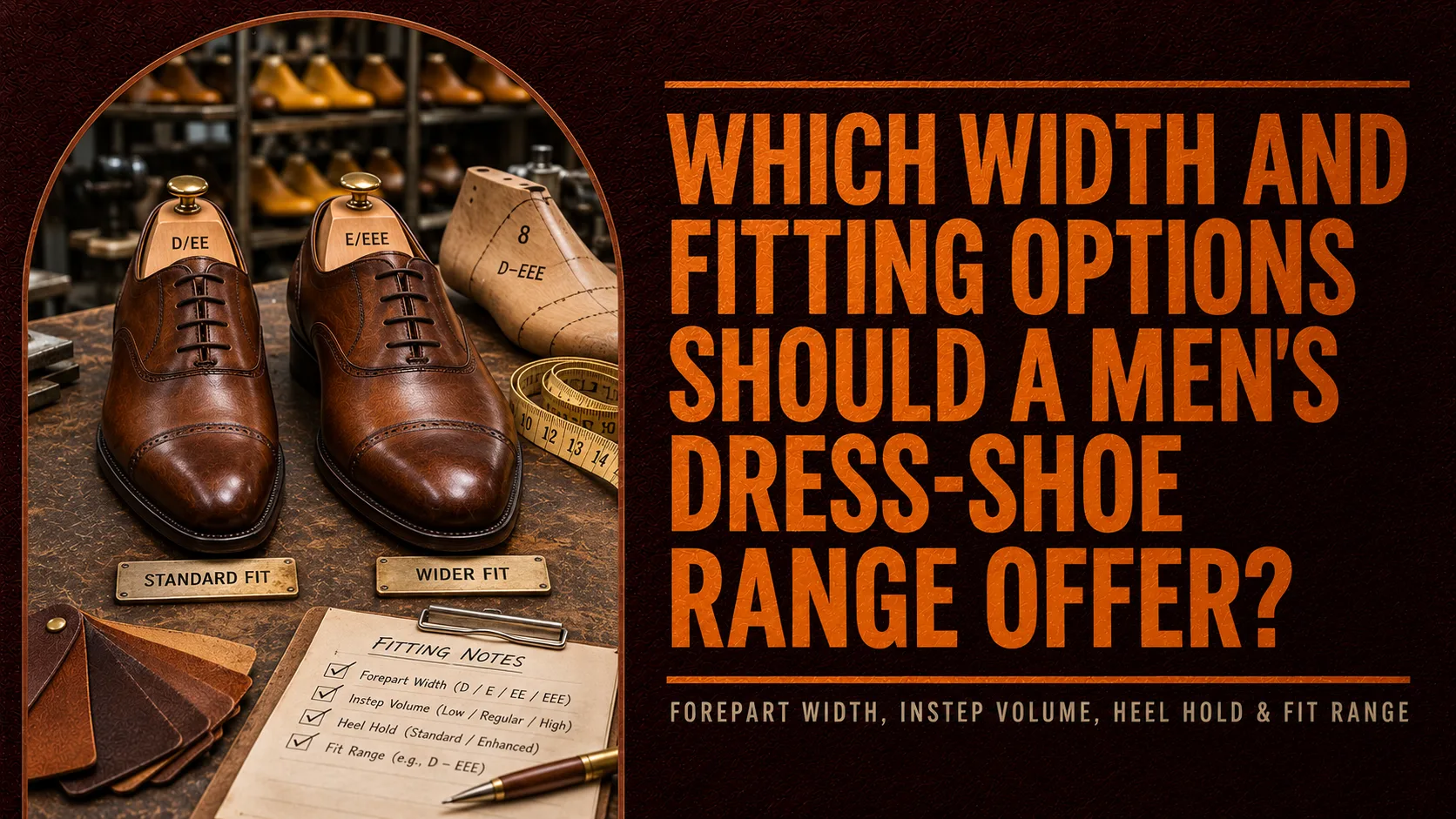
The target population also defines limits. A last may serve one group well while failing another with a different instep or forepart shape. That does not make the last defective in every use; it means the buyer must state whom the shoe is designed for and decide whether another width or last family is needed for a wider offer. A new series cannot legitimately claim a broad fit range solely because its size labels cover many numbers. The relevant question is whether the forms behind those labels preserve workable relationships for the intended feet.
Which dimensions are constraints and which are styling choices?
The functional relationships at the ball, forepart, instep and heel are constraints for the intended wearer. The external toe shape, apparent length and some contour choices are styling goals that must be negotiated around those constraints. A pointed toe can be visually extended without demanding that toes occupy its tip; alternatively, a narrow forepart can create pressure even in a shoe that looks long. A buyer should distinguish those two designs before approving the silhouette. The available tradeoff is not “fit or style” in the abstract. It is which part of the last can move or lengthen while preserving space and flex where the foot needs it. Without a sample and relevant measurements, no general millimeter allowance or universally safe pointed shape can be stated.
How do silhouette and upper design change the choice?
The intended shoe must be considered while the last is selected. Toe outline, heel height, toe spring and bottom shape affect its appearance and physical interface with upper and sole components. The upper’s opening and method of securing the foot influence how a given space feels and whether the heel stays in place. SATRA’s last verification discussion explains that last geometry is central but construction, materials, shoe style and fastening also affect finished fit. Thus a buyer should not approve a last for an entire formal line based only on one bare form or one style’s sample.
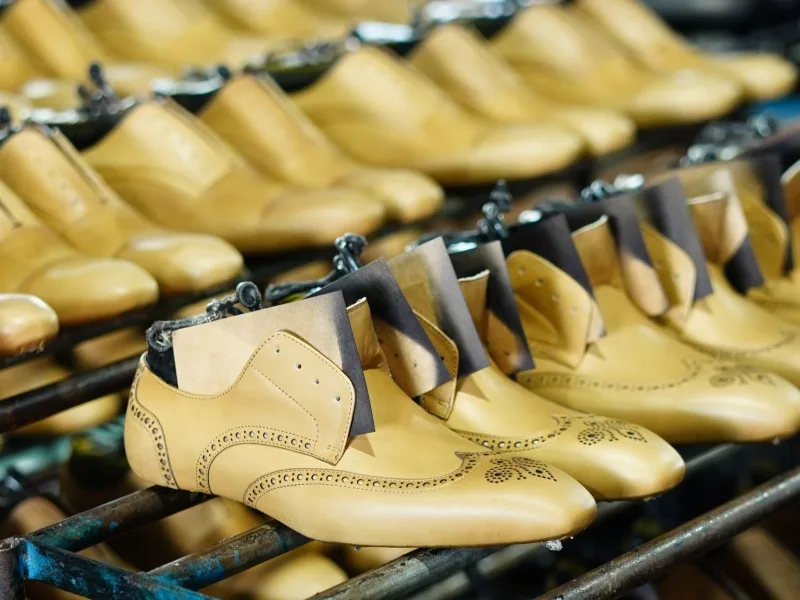
This relationship matters when a last is modified for appearance. A longer-looking toe is not necessarily a larger usable foot chamber; a change to the bottom or heel can require reconsidering the sole and upper pattern. Conversely, a shoe that looks similar from above may use a different opening or rear structure and feel different on the same foot. The buyer should ask which parts of the intended silhouette depend on the last, which depend on the upper, and whether a proposed adjustment preserves the target-foot geometry. These are design dependencies, not a ranking of Oxford, Derby or loafer comfort. The site’s formal dress shoe category can help a buyer browse style families when defining the range; it does not report which of those styles uses a particular last or fits a given foot.
Can one last serve several dress shoe styles?
One last can be a starting point for several styles if each finished upper and fastening arrangement still suits the intended foot. That possibility can reduce unnecessary variation, but common tooling alone is not evidence of common fit. Compare each intended sample at the ball, instep and heel and note whether the upper permits adjustment or relies on a closer fixed opening. If the resulting fit differs, either the upper design, last choice or size guidance may need to change. This is a range-level selection criterion. It is not a complete diagnosis of why two already released same-size shoes feel different, and it does not imply that any named shoe style is always more accommodating.
When should a buyer reuse, modify or develop a last?
Reuse an existing last when its critical geometry, intended foot group and proposed shoe structure align. Modify it when a mismatch is clearly located and the change can be evaluated together with its effects on upper and bottom components. Develop a new last when the old form’s central geometry cannot satisfy the target foot and silhouette at the same time. These are conditional routes derived from last measurement and verification principles, not fixed industry thresholds or evidence of a particular factory’s capabilities. They require comparison of the actual candidate form and a finished sample.
| Last route | When it is justified | Main risk | What demonstrates suitability |
|---|---|---|---|
| Reuse an existing last | Target feet and intended shoe align at ball, instep, heel and bottom. | A familiar last hides a mismatch in the new style. | Compare key dimensions and an appropriate finished sample. |
| Modify a last | A defined local mismatch can be corrected without losing essential adjacent relationships. | An edit changes upper pattern or sole interface elsewhere. | Remeasure changed and adjacent geometry, then assess a made shoe. |
| Develop a new last | Core geometry cannot serve target feet and silhouette together. | No existing validated size family transfers automatically. | Establish a master-size basis, then examine edge and width variants. |
The table separates a route’s reason from its proof. It cannot predict cost or lead time. The decisive common requirement is a finished shoe whose fit demonstrates that the chosen route addressed the target-foot and silhouette conflict.
How can a local modification create a new mismatch?
A local edit affects a connected form. Increasing forepart space may change how the upper pattern wraps the ball; altering heel or bottom geometry may change the sole interface or rear hold. SATRA’s account of digital last modification describes how toe, forepart, rear and bottom regions can be adjusted and then used in making other components. It does not say any edit is harmless or that a particular supplier can make it. After a proposed correction, compare the modified last with the target foot at the intended point and with the untouched neighboring regions. Then examine a finished sample, because material and construction can change the result. This is why “just widen the toe” may be an inadequate instruction when the pressure is at the ball or instep.
Why is one approved master size insufficient?
A master size establishes a starting form, not proof for every size in the range. Grading creates related forms, but changes in ball position, width/girth, instep and heel relationships need examination across the proposed series. Shoemakers Academy describes last measurements and grading; from that, it follows that a size-family decision should check whether the critical geometry remains suitable outside the master size. The principle does not assert a particular grading increment or a known error at the smallest or largest size. It identifies what a buyer must not assume from one successful sample.
The risk is especially visible when the series includes a width branch or a broad span of lengths. Scaling one dimension does not automatically preserve the same functional relation for every target foot. A buyer can compare key landmarks on representative edge forms and then examine finished samples where the fit decision is most likely to change. The output is an approved range with a stated boundary, not an attractive master sample accompanied by unexamined size labels. Order quantities for each size are a separate inventory task; here the issue is whether the proposed last series can produce appropriate shoes at those labels.
Which range points deserve a separate check?
Check the proposed smallest and largest sizes and any width branch whose geometry or target foot group differs materially from the master size. Compare ball placement, forepart and instep allowance and heel relationship with the corresponding wearer group, then assess finished samples. These points are not chosen because end sizes are inevitably wrong; they are chosen because the master sample cannot logically establish their outcome. If one end fails, revise the graded form, narrow the approved range or reconsider the last family rather than covering the mismatch with a converted size label. A full representative-wearer trial, including recruitment and formal recording, belongs to a separate testing task.
What warrants approval or a return to the last design?
Approve the last route when four things agree: the target-foot landmarks, the selected or modified last geometry, the intended dress shoe silhouette and the finished sample’s observed fit. The approval should state which foot group, shoe style and size range the judgment covers. Digital measurement or visual comparison can reveal geometric mismatches, but it predicts rather than replaces the experience of a made shoe. If achieving the silhouette requires sacrificing essential forepart space or heel hold, return to the last or design choice. If a single master sample works but edge forms have not been checked, approve only the tested scope, not the whole range.
That decision is more useful than a generic instruction to request a last drawing. It tells the buyer what the drawing and sample must show and what conflict would change the decision. It also prevents an old last from being reused merely because it is available or a new last from being commissioned merely because the design is new. The three routes have distinct reasons and risks; the approved one should solve the relevant geometric problem without introducing another. Where project-specific foot data or finished samples are missing, the general method still explains the choice, while the exact product conclusion remains open.
With a defined target foot, silhouette and acceptance boundary, the buyer can discuss which actual lasts and samples are available for the project and whether modification or new development is feasible. A proposed last should remain open to revision until a finished shoe and the relevant size range support the choice.